Dragon Boat Festival: Origins, Food, Races & 2026 Events
On June 19, 2026, the Dragon Boat Festival (also called Duanwu Festival) returns, centering on races that few people realize commemorate a grieving poet’s final act. Beyond the paddling, the holiday is built around one food that millions of families prepare together, regional customs that vary wildly from province to province, and protective rituals designed for a season when illness once spread quickly.
Lunar Date: 5th day of 5th lunar month · 2026 Date: June 19 · Age: about 2,000 years · UNESCO Status: Intangible Cultural Heritage · Key Food: zongzi (sticky rice dumplings)
The snapshot below distills confirmed facts alongside open questions and a timeline that runs from the Warring States period through the 2026 celebrations.
Quick snapshot
- Festival date tied to lunar calendar (China Highlights)
- Qu Yuan legend is the dominant origin story (National Today)
- Zongzi and races are the two core traditions (Eskimo Travel)
- UNESCO listed the festival in 2009 (China Educational Tours)
- Exact biggest festival by participant count — no authoritative ranking
- Full 2026 global event schedule beyond major cities — details not publicly confirmed
- Specific health warnings for realgar wine (arsenic risk) — medical guidance limited
- ~278 BC: Qu Yuan drowns himself (National Today)
- c. 2,000 years ago: festival traditions emerge (National Today)
- 2009: UNESCO recognizes Duanwu Festival (National Today)
- June 19, 2026: Mainland China holiday begins (National Today)
- Singapore races June 19, 2026 (China Highlights)
- Ireland Athy regatta May 3; Barrow June 7 (China Highlights)
- Mainland China 3-day holiday June 19–21 (China Highlights)
The key facts below establish the official naming, lunar positioning, and UNESCO recognition that define this observance.
| Field | Value |
|---|---|
| Official Name | Duanwu Festival |
| Lunar Date | Fifth day, fifth month |
| Gregorian Timing | Late May to early June |
| UNESCO Listing | Intangible Cultural Heritage (2009) |
| Patron Figure | Qu Yuan, poet and statesman |
What is the Dragon Boat Festival and why is it celebrated?
The Dragon Boat Festival is one of China’s oldest and most widely observed holidays, falling each year on the fifth day of the fifth lunar month — a date that shifts between late May and early June on the Gregorian calendar. In 2026, that date lands on June 19. The holiday combines competitive races, ritual food, and protective customs into a single observance that has survived for roughly 2,000 years.
History and origin
The festival’s most widely told origin centers on Qu Yuan, a poet and minister during the Warring States period more than 2,000 years ago. After being exiled for his political convictions, Qu Yuan drowned himself in the Miluo River when he learned that his home state of Chu had fallen to Qin forces. According to accounts, local people raced out in boats to search for his body — and dropped rice dumplings into the water to keep fish from eating it (National Today). That story, simplified over centuries, anchors the two practices that define the holiday today: dragon boat races and zongzi.
Connection to Qu Yuan
Qu Yuan’s story is a large part of why the festival carries weight beyond mere seasonal celebration. His reputation as a loyal, principled figure made him a symbol of patriotism across Chinese history. The races are said to echo the original search parties; the dumplings evolved from offerings to practical food that fishermen could use. China Educational Tours notes that festival customs in some regions also include climbing mountains or hanging protective herbs — older traditions that predate the boat races and may reflect separate seasonal-health practices that merged over time.
The implication: the festival layers multiple traditions on top of the Qu Yuan story, which means visitors who arrive expecting a single narrative will find something more complex and regionally varied than the simplified legend suggests.
What food is eaten during the Dragon Boat Festival?
Zongzi is the centerpiece without question — sticky rice dumplings wrapped in bamboo leaves, bound with twine, and steamed or boiled for hours. But the fillings, shapes, and even the logic behind eating them vary enough that regional food alone could fill a separate guide.
Zongzi preparation
- Leaves: bamboo or reed leaves soaked, cleaned, and folded into cone or rectangular shapes
- Fillings: differ sharply by region (see below)
- Binding: twine tied before cooking; dumpling is eaten unwrapped after steaming
- Symbolic origin: rice was reportedly thrown into the river to protect Qu Yuan’s body from fish
Other traditional foods
Beyond zongzi, several other foods appear in specific regions:
- Realgar wine — drunk at the festival to ward off evil spirits and pests, historically used for disinfection when resources were limited (The China Journey, China Educational Tours)
- Jiandui — fried dough cakes in Fujian, associated with “mending the sky” during the rainy season (China Highlights)
- Mianshanzi — fan-shaped wheat flour food eaten in Gansu Province and Wenzhou (China Highlights, Tourist Maker)
- Eel — eaten in Wuhan for seasonal nutrition and health benefits (China Highlights)
- Tea eggs and salted eggs — part of the “five yellow foods” tradition in some areas, eaten for health during the transitional summer season
What this means: regional food variations are not minor preferences — they reflect genuine north-south and province-level culinary divides that shape family kitchens every festival season.
Northern China reaches for sweet zongzi with red bean paste or dates. Southern and Cantonese regions pack theirs with savory fillings — pork belly, salted egg yolk, mushrooms. Fujian takes a middle path with braised pork, chestnuts, and mushrooms. This is not a minor preference variation: it reflects a genuine north-south culinary divide that colors family kitchens every festival season.
What to See and Do During the Dragon Boat Festival?
The races are the headline event for visitors and participants, but they sit within a wider set of activities that most guides underplay.
Boat races
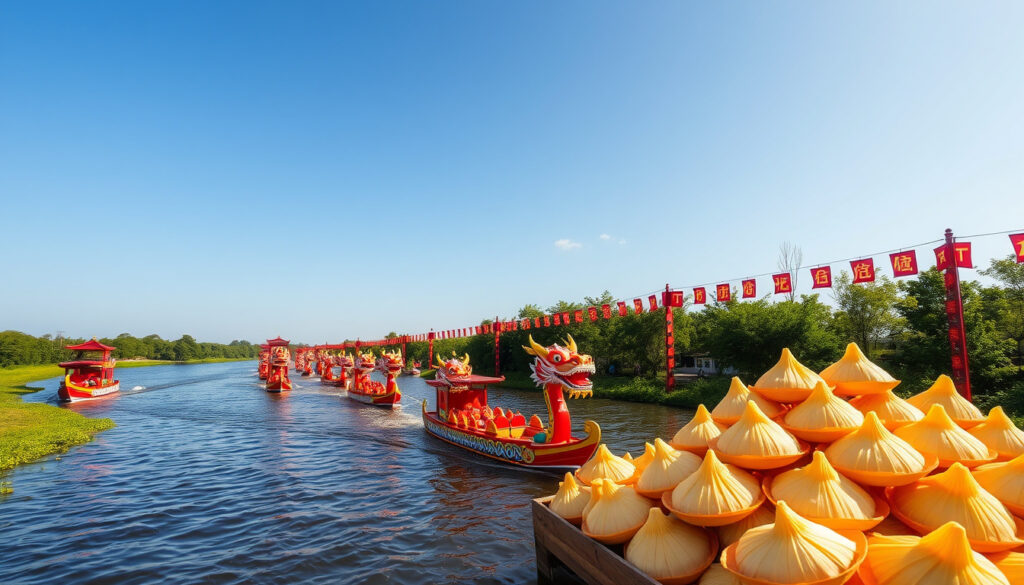
Dragon boat races are competitive team events held on rivers, lakes, and coastal waters across China and in Chinese diaspora communities worldwide. Boats can reach 100 feet in length with up to 80 rowers, all working to a drummer’s beat that keeps the stroke synchronized (National Today). The races carry symbolic weight — the original story involves a search party — but for modern participants they are primarily a test of coordination and endurance. Singapore hosts international races on June 19, 2026 (China Highlights); Ireland’s Athy and Barrow regattas draw their own dedicated crews and crowds.
Other customs like hanging herbs
- Hanging mugwort and calamus — placed above doorways to ward off illness during the summer transition season
- Scented sachets for children — small cloth pouches worn or hung on the chest, sometimes decorated with five-color silk threads to scare evil spirits (China Educational Tours)
- Realgar wine — used externally or consumed in small amounts to repel pests and evil influences (The China Journey)
- Egg balancing at noon — practiced in Taiwan as a fortune-bringing ritual at the festival’s solar peak (Tourist Maker)
- Mountain climbing — a northern China tradition that predates the boat races, performed early in the morning for health and protection (China Educational Tours)
The pattern: the holiday was built partly around seasonal health management. Before modern medicine, the fifth lunar month was a risky time — heat and humidity drove pests and disease. Families used the festival to collectively address that vulnerability.
Most coverage focuses on the races. But the protective customs — hanging herbs, sachets, realgar wine — reveal that the holiday was built partly around seasonal health management. Before modern medicine, the fifth lunar month was a risky time: heat and humidity drove pests and disease. Families used the festival to collectively address that vulnerability.
What do Chinese people do during Dragon Boat Festival?
Beyond races and food, the festival is shaped by superstitions, taboos, and family rituals that regulate what people do — and don’t do — on the day itself.
Taboos and superstitions
Research on explicit food taboos during the festival is thin, but the pattern that emerges from multiple sources is consistent: the holiday is framed around proactive protection rather than prohibition. Realgar wine, five-yellow foods, and herb hanging are all positioned as preventive measures (China Xian Tour, Odynovo Tours). The logic connects to the season — the fifth lunar month historically coincided with the onset of summer illnesses — and the idea that the festival should reset the household against those risks. Cold foods are sometimes avoided, with the thinking that the body should not be chilled during this transitional period (Odynovo Tours).
Family traditions
- Cleaning the house — sweeping and tidying before the festival day, partly practical and partly symbolic, clearing the home before protective herbs go up
- Making zongzi together — extended families gather to stuff, wrap, and boil dumplings; the act of eating the same dish on the same day each year becomes a way of staying connected to family history
- Visiting relatives — the holiday is one of the few occasions when rural and urban family members typically gather
The catch: for most families, the festival’s private side — cleaning, cooking, wearing sachets — matters as much as the public races. The holiday’s meaning is split between community spectacle and household ritual.
Where is Dragon Boat Festival 2026?
The festival is observed wherever Chinese communities exist, but the scale of 2026 celebrations varies widely — from a mainland national holiday to local regattas in Ireland.
Major global locations
- Mainland China — three-day national holiday from June 19 to June 21, 2026; races in virtually every river city, plus food markets and family gatherings (China Highlights)
- Hong Kong, Macau, Taiwan — one-day public holiday on June 19, 2026; scaled-back but well-attended events (China Highlights)
- Singapore — international dragon boat races on June 19, 2026, with food stalls and cultural performances; draws teams from across Asia-Pacific (China Highlights)
- Ireland — Athy Dragon Boat Festival on May 3, 2026; Barrow Dragon Boat Regatta on June 7, 2026; both are longstanding community events outside China with their own traditions
- Seattle — Dragon Boat Festival features races, cultural performances, and Indigenous elements, though full 2026 details were not fully confirmed at time of research (Discover South Lake Union)
Biggest festivals
Pinpointing a single “biggest” festival depends on what metric is used — number of boats, number of spectators, prize money, or tradition length. Guangzhou, Hong Kong, and Shanghai all stage large-scale events with dozens of crews. Internationally, Singapore’s races have earned a strong reputation for organization and scale. Ireland’s regattas are smaller but have the unusual distinction of sustaining dragon boat traditions in a non-Chinese community for years. What is clear is that the festival has moved well beyond China: it is one of the few traditional Chinese holidays that has genuinely taken root in Western cultural calendars.
The trade-off: the festival’s global spread creates richer options for spectators and participants, but it also dilutes some traditional meanings. A race in County Kildare or South Lake Union is a different event from a riverside ceremony in Guangdong. The food and customs often travel with the diaspora, but the regional specificity — Wuhan eels, Fujian jiandui — gets smoothed out. For visitors who want the full cultural picture, China remains the most complete version of the holiday.
The festival’s global spread creates richer options for spectators and participants, but it also dilutes some traditional meanings. A race in County Kildare or South Lake Union is a different event from a riverside ceremony in Guangdong. The food and customs often travel with the diaspora, but the regional specificity — Wuhan eels, Fujian jiandui — gets smoothed out. For visitors who want the full cultural picture, China remains the most complete version of the holiday.
Dragon boat races and rice dumplings are two of the most distinctive elements of the festival. — China Highlights, Travel Guide
It is a festival shaped by history, food, and seasonal rhythm. — Wong’s Chinese Barry, Cultural Blog
The 2026 Dragon Boat Festival arrives on June 19. For families in China, it means three days of national holiday, a house hung with herbs, and a pot of zongzi on the stove. For paddlers in Singapore or Ireland, it means weeks of training for a race where the drum beat and the boat’s dragon head are the same ones that fishermen first heard on the Miluo River. The holiday works on both scales — intimate and massive — and that is exactly what has kept it alive for 2,000 years.
Related reading: Chicken and Rice Recipes · Carnival Adventure Ship Itineraries
Frequently asked questions
Is it okay to say happy Dragon Boat Festival?
Yes. The festival is a celebration, and well-wishes are appropriate. Some people prefer “Duanwu Jie kuai le” in Chinese, but wishing someone a happy Dragon Boat Festival in English is understood and welcomed in most settings.
Do Vietnamese celebrate Dragon Boat Festival?
Vietnam observes its own version called Doan Ngo Festival on the fifth day of the fifth lunar month, sharing Chinese-origin traditions including zongzi-like cakes and protective customs. The core practices overlap, but the cultural framing differs.
Where is the biggest Dragon Boat Festival in the world?
No single event is universally ranked as the largest. Major metropolitan events in Guangzhou, Hong Kong, and Shanghai are among the largest in China. Singapore’s international races are considered among the best-organized outside China. The term “biggest” depends on whether you measure by boats, participants, or spectators.
What are some Dragon Boat Festival taboos?
Research on specific food taboos is limited. The broader pattern emphasizes proactive protective measures — hanging herbs, drinking realgar wine, wearing sachets — rather than list-style prohibitions. Cold foods are sometimes avoided around the festival for seasonal health reasons. The key is that the holiday traditionally focused on guarding against illness rather than forbidding particular foods.
Where do the strongest paddlers sit in a dragon boat?
Position assignment varies by team, but typically the strongest paddlers sit near the middle of the boat where the leverage for stroke rhythm is most effective. The drummer at the front sets the pace, and the steer at the tail controls direction. In competitive races, rower placement is a tactical decision.
What is the story behind Dragon Boat Festival?
The dominant story centers on Qu Yuan, a poet and minister from the Warring States period. After political exile, he drowned himself in the Miluo River upon learning that his state had fallen. Local people raced out in boats to search for his body and dropped rice dumplings to protect it from fish — the two acts that became the holiday’s defining practices.
What are Dragon Boat Festival races?
Dragon boat races are team-based rowing competitions held on waterways during the festival. Boats are typically 80 to 100 feet long, with up to 80 rowers working to a drummer’s beat at the bow. Races are held in cities and towns across China and in Chinese diaspora communities globally, ranging from neighborhood competitions to international invitational events.
More related posts
 Abby Boom: Age, Real Name, and Controversies Explained
 Will.i.am Net Worth, Stage Name Meaning, and Black Eyed Peas Facts
 Bukayo Saka: Religion, GCSEs, Girlfriend, and Biography
 Julie Walters: Health Update, Diagnosis, and Career Highlights
 Jarome Luai: Contract, Salary, Family, PNG Chiefs & NRL Move 2025
 Liza Minnelli: Health, Family, Inheritance, and Net Worth
 Insta360 X5: 8K 360 Camera Specs, Price & X4 Comparison
 Joel Embiid: Injury, Wife, Height, Retirement Status