How to Get Rid of Hiccups Fast with Proven Remedies
Hiccups strike without warning and refuse to leave on command. The internet is full of tricks — hold your breath, drink water backwards, scare yourself silly — but which ones actually work? This guide cuts through the noise with medical sources and hands-on pressure point techniques to stop hiccups fast, whether you’re at home or dealing with a newborn.
Typical duration: under 48 hours · Common cause: diaphragm spasm · Proven remedies: hold breath, sip cold water · Acupressure points: jaw, upper lip, chest · When to see doctor: lasting over 48 hours
Quick snapshot
- Breath holding stops most cases per NHS
- Cold water sip effective per Cleveland Clinic
- TE17 acupressure showed 92.6% efficacy in 148 chronic cases per McGill University
- Unverified internet “tricks” lack peer-reviewed support
- Oxygen-deprivation claim is a common myth
- Individual variation in remedy effectiveness
- Most hiccups resolve within minutes to hours
- Persistent cases (over 48h) warrant medical attention
- Newborn hiccups are normal; infant hiccups rarely harmful
- Try breath holds and cold water first at home
- Move to pressure point techniques if symptoms persist
- Consult a doctor if hiccups last beyond two days
| Key fact | Detail |
|---|---|
| Most common cause | Stomach distension |
| Average length | Few minutes to hours |
| Tier 1 remedy source | NHS, Cleveland Clinic |
| Acupressure efficacy | Allina Health points |
How do I get rid of hiccups fast?
When hiccups strike, most people reach for whatever trick worked once before. The fastest approaches don’t require any equipment — just your lungs and cold water.
Breathe into paper bag
- Place a paper bag over your mouth and nose
- Breathe in and out steadily for 15–30 seconds
- The increased carbon dioxide relaxes the diaphragm
According to WebMD, breathing into a paper bag is a simple way to interrupt the hiccup reflex. Stop if you feel dizzy.
Sip ice-cold water
- Drink a glass of ice water quickly but without gulping
- Swallow the water in small, controlled sips
- The cold temperature shocks the diaphragm
The Cleveland Clinic specifically recommends this approach. The temperature change stimulates the vagus nerve, which helps reset the hiccup cycle.
Hold your breath 5–10 seconds
- Take a deep breath and hold it without exhaling
- Count to 10 (or up to 20 for stubborn cases)
- Exhale slowly through pursed lips
Research from the NHS confirms that breath holding stops most acute hiccup episodes. The retained carbon dioxide suppresses the hiccup reflex.
Pull your knees to chest
- Sit down and pull your knees up toward your chest
- Hold the position for 20–30 seconds
- Release and repeat as needed
This compresses the diaphragm and can interrupt spasms, according to Allina Health guidance on home remedies.
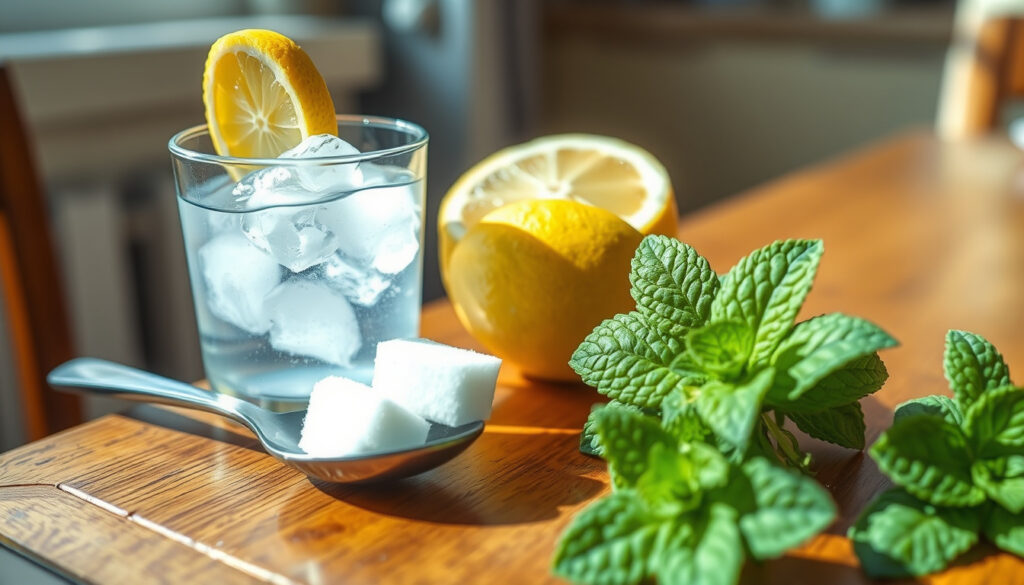
Swallow granulated sugar
- Place a teaspoon of granulated sugar on your tongue
- Let it dissolve without chewing
- The grainy texture interrupts nerve signals
The NHS notes this as a simple trick that works for many people. The rough texture stimulates the vagus nerve via the throat.
Valsalva maneuver
- Take a deep breath and hold it
- Bear down as if having a bowel movement
- Hold for 10–15 seconds, then release
This increases chest pressure and stimulates the vagus nerve. WebMD notes that deep breathing combined with pressure techniques helps relax the diaphragm.
What causes hiccups?
Understanding why hiccups start helps you choose the right remedy. The mechanism is straightforward, but triggers vary.
Diaphragm irritation
The diaphragm is a dome-shaped muscle at the base of your lungs. When it spasms involuntarily, it causes a sudden intake of air that gets stopped by your vocal cords, producing the “hic” sound. WebMD explains that the area of skin covering the earlobe pressure point is linked to the diaphragm through nerves, which is why facial stimulation can affect diaphragmatic function.
Common triggers
- Eating too fast: Swallowing air along with food distends the stomach
- Carbonated drinks: The bubbles irritate the diaphragm
- Sudden temperature changes: Cold water or hot food can trigger spasms
- Spicy foods: Irritate the esophagus and stomach lining
- Alcohol: Can affect nerve function and stomach distension
- Excitement or stress: Triggers involuntary nervous system responses
Nervous system involvement
The vagus nerve connects the brain to the abdomen, and the phrenic nerve controls the diaphragm directly. When either gets irritated — from stomach distension, temperature changes, or nerve stimulation — the hiccup reflex activates. According to research published in PubMed Central, abnormal vagus nerve excitement contributes to hiccups, and stimulating specific acupoints can inhibit this response by exciting the cerebral cortex’s high-level center.
Stomach distension is the most common trigger for ordinary hiccups. Eating slower and avoiding carbonated drinks prevents most episodes before they start.
Which finger do you press for hiccups?
Acupressure targets specific points connected to the diaphragm through nerve pathways. Three main areas work: the jaw, upper lip, and chest.
Jaw acupressure point (TE17)
- Locate the small indent behind your jawbone, just below the earlobe
- Press gently for 1–2 minutes while practicing deep breathing
- Apply moderate pressure — it should feel tender but not painful
The Allina Health (an integrated health system) describes this technique as effective for many people. A 2003 study found that applying pressure to this point was 92.6% effective in treating chronic hiccups in 148 cases, according to McGill University’s Office for Science and Society.
Upper lip point
- Find the space between your upper lip and the base of your nose
- Press firmly upward for 20–30 seconds or longer
- Combine with deep breathing cycles
According to Allina Health, this point is located in a sensitive area with nerve connections to the diaphragm. The pressure stimulates local nerves that share spinal innervation with the breathing muscle.
Chest point
- Locate the area just below your collar bones
- Press and hold for 20–30 seconds while focusing on slow breaths
- Repeat several times if needed
As Allina Health notes, the chest acupressure points are located under the collar bones and should be pressed while focusing on deep breathing for best results.
Studies on acupressure for hiccups have shown high likelihood of bias and a dearth of scientific evidence per McGill University. Deep breathing exercises practiced parallel to acupressure may be the primary reason hiccups resolve rather than acupressure alone.
Are hiccups a sign of something serious?
For most people, hiccups are harmless and resolve on their own within minutes. But there are situations where medical attention is warranted.
When to worry
According to the NHS, see a doctor if hiccups last more than 48 hours. Persistent hiccups can signal underlying conditions including stroke, multiple sclerosis, or tumors affecting the nervous system. The vast majority of cases are not serious, but prolonged episodes deserve professional evaluation.
Persistent hiccups
Cases lasting more than two days are considered persistent and may require medication or nerve blocks. Research published in PubMed Central shows that acupuncture may be a clinically useful, safe, and low-cost therapy for persistent hiccups in cancer patients, resulting in significant reductions in discomfort, distress, and fatigue.
Rare warnings
The notion that hiccups indicate oxygen deprivation is a myth. WebMD clarifies that the hiccup reflex is not related to oxygen levels — it’s a nerve-circuit phenomenon. Hiccups do not cause oxygen deprivation in healthy individuals.
Ordinary hiccups are a nuisance, not a warning. For healthy people, the rule is simple: try home remedies for 48 hours, then call your doctor if they persist.
How to get rid of hiccups in newborns?
Newborn hiccups are completely normal and usually harmless. Infants hiccup more frequently than adults because their digestive and nervous systems are still developing.
Gentle burping
- Hold baby upright over your shoulder
- Pat the back gently until they burp
- Burping releases swallowed air that may cause hiccups
According to guidance from Allina Health, special care is needed for infants — avoid forceful methods.
Upright holding
- Keep baby upright for 15–20 minutes after feeding
- This helps the diaphragm settle and reduces spasm frequency
- Avoid placing baby flat immediately after eating
Pacifier use
- Offer a clean pacifier during hiccup episodes
- The sucking motion helps regulate breathing rhythm
- Swallowing can reset the diaphragm reflex
The NHS notes that infant hiccups rarely require intervention. Unlike adult remedies, never attempt breath holds, paper bags, or startling an infant — these methods are dangerous for babies.
Adult remedies like breath holds or carbonated water are off-limits for newborns. Patience and gentle upright positioning are the only tools parents need — hiccups typically resolve on their own within minutes.
Related reading: Paw Paw Ointment: Uses, Benefits, Safety & Ingredients · Postural Orthostatic Tachycardia Syndrome Symptoms – Key Insights
moxa.care, frontiersin.org, youtube.com, albanacupuncture.com, scottsdalelibertyhospital.com, relainstitute.com
Guides like this effective remedies guide reinforce proven techniques such as breath holding and acupressure for stopping sudden diaphragm spasms quickly.
Frequently asked questions
What is the weird trick for hiccups?
The “weird trick” most often cited involves pulling your tongue or gargling with water. While popular online, these techniques lack robust peer-reviewed verification. More evidence-backed options — like holding your breath or sipping cold water — work faster for most people.
How to stop hiccups instantly at home?
The fastest home methods are holding your breath for 10–20 seconds or drinking ice water quickly. Both approaches target the vagus nerve and diaphragm reflex directly. The Cleveland Clinic recommends cold water as a first-line approach.
How to stop hiccups in 20 seconds?
Take a deep breath, hold it for 20 seconds, then exhale slowly. This builds carbon dioxide levels and suppresses the diaphragm spasm. Alternatively, drink a glass of ice water as quickly as possible without gulping — the temperature shock often stops hiccups within seconds.
What are hiccups?
Hiccups are involuntary spasms of the diaphragm muscle, followed by a sudden closure of the vocal cords. The sound (“hic”) is created when air rushes in against the closed glottis. The reflex is controlled by the vagus and phrenic nerves.
How do you get rid of hiccups in 10 seconds?
Drink cold water backwards (from the far rim of the glass) or perform a quick Valsalva maneuver (bearing down as if having a bowel movement while holding your breath). Both techniques work within 10–30 seconds for many people.
Are hiccups a lack of oxygen?
No. This is a common myth. Hiccups are not caused by oxygen deprivation — they’re a nerve reflex triggered by diaphragm irritation or stimulation. Holding your breath works precisely because it increases carbon dioxide, not because it changes oxygen levels.
What is a hiccup caused by?
Hiccups are caused by involuntary diaphragm spasms triggered by irritation of the phrenic nerve, vagus nerve, or stomach distension. Common triggers include eating too fast, carbonated drinks, sudden temperature changes, and excitement or stress.
More related posts
 Reese Witherspoon: Facts, Myths, and Top Questions Answered
 Walking Pad Kmart – Availability, Prices and Reviews Guide
 Marina Prior: Biography, Age, Career, and Personal Life
 Jimmy Butler Bio, Stats, Injury, and Personal Life
 Cast of Dawson’s Creek – Full Actors List and Careers
 Touk Miller: Ethnicity, Father, Partner, Age, and Career Profile
 Rob Hirst: Midnight Oil Drummer Dies at 70 from Pancreatic Cancer
 Princess Diana: Answers to Top Questions About Her Death and Life