Rabbit Proof Fence: History, True Story and 2002 Film Guide
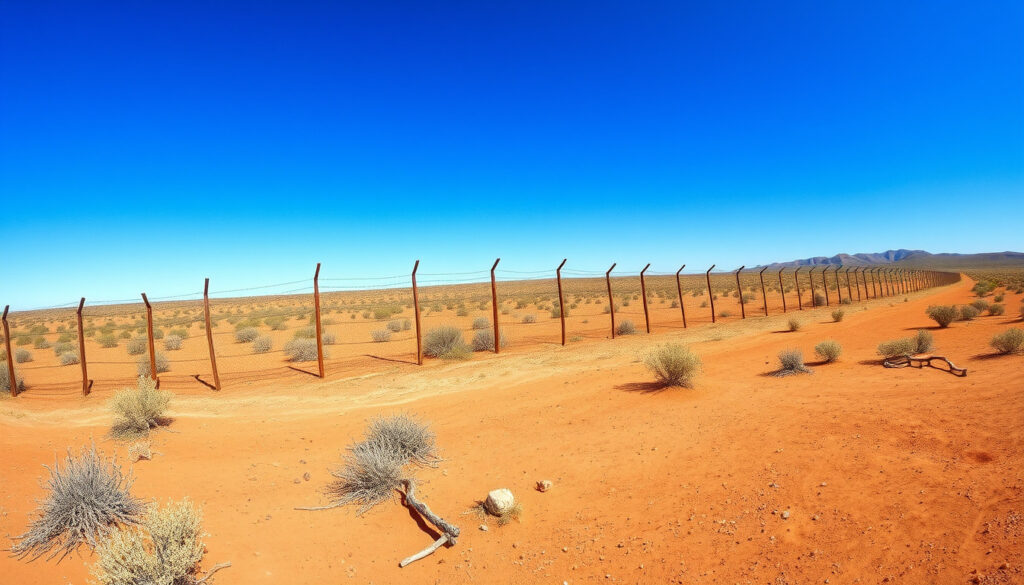
Three Aboriginal girls escaped a government settlement in 1931 and walked 1,600 kilometres home using a rabbit fence as their only guide—proving that colonial infrastructure built to control the land could also become an instrument of resistance.
Fence Length: 1,166 km (Number 2) · Girls’ Walk: 1,600 km · Film Release: 2002 · Built: 1905 · Walk Duration: Nine weeks
Quick snapshot
- Number 2 Rabbit Proof Fence stretches 1,166 km from Point Ann through Cunderdin (State Library of Western Australia)
- The girls followed the fence 1,600 km back to Jigalong in 1931 (She’s Probably At The Library)
- Rabbit-Proof Fence film released in 2002, directed by Phillip Noyce (State Library of Western Australia)
- Molly Craig was 14 at time of removal (Offscreen film analysis)
- The exact day and month of the 1931 removal and escape remain unspecified in available records
- Detailed post-escape life outcomes for Daisy and Gracie are lacking in primary sources
- Gracie’s fate after recapture is not fully documented in surviving records
- Fence construction: 1901–1905
- Stolen Generations removals: 1905–1967
- 1931 escape documented
- 2002 film released
- Historical site preservation efforts continue in Western Australia
- The story remains part of ongoing national conversations about recognition and reconciliation
The table below consolidates key facts about the fence, the walk, and the film.
| Label | Value |
|---|---|
| Original Purpose | Stop rabbit plague |
| Fence Length | 1,166 km |
| Walk Distance | 1,600 km |
| Film Runtime | 94 minutes |
| Based on Book | Doris Pilkington |
What was the rabbit proof fence?
The Rabbit-Proof Fence—officially known as the State Barrier Fence—began construction in 1901 to control exploding rabbit populations that had been introduced by English settlers in the 1880s. By 1902, rabbits had already breached the initial fence line, prompting the construction of Number 2 Rabbit Proof Fence in 1905 (State Library of Western Australia). Historical estimates suggest the rabbit population in Australia reached into the billions at its peak.
Purpose and construction
The barrier was designed as an agricultural defensive measure, intended to prevent rabbits from consuming native vegetation and destroying farmland across Western Australia. The fence stretched from Point Ann near Esperance through to Cunderdin—a distance of 1,166 kilometres (State Library of Western Australia).
Number 2 fence details
Number 2 remains the longest continuous fence in the world, standing as a remarkable feat of early 20th-century rural engineering. Unlike conventional farm fencing, the State Barrier Fence was designed to withstand the pressures of a determined pest species.
Is Rabbit-Proof Fence based on a true story?
Yes. The 2002 Australian film directed by Phillip Noyce dramatizes the 1931 escape of three half-caste Aboriginal girls: Molly Craig (14), Daisy Kadibil (8), and Gracie Fields (10) (Offscreen film analysis). The story is detailed in Doris Pilkington’s 2002 book Rabbit-Proof Fence: The True Story of One of the Greatest Escapes of All Time, written by Molly Craig’s daughter (She’s Probably At The Library).
The stolen generations context
The Stolen Generations refers to Aboriginal and Torres Strait Islander children removed from families by Australian governments and churches between approximately 1905 and 1967, with some removals extending into the 1970s (Wikipedia overview). Child removals were part of deliberate policies aiming for the “disappearance of Aborigines as a people” based on racist assumptions (Ronin Films documentary).
Removing children was a deliberate government policy and the end aimed for was the eventual disappearance of Aborigines as a people.
— Marcia Langton and Henry Reynolds, historians (Ronin Films)
Book by Doris Pilkington
Doris Pilkington (1962–2011) was born to Molly Craig after Molly’s escape. She later documented her mother’s story in the book that became the basis for the film. Policies specifically targeted “half-caste” children, believed to be more intelligent and therefore more assimilable (She’s Probably At The Library).
How long did Molly Craig walk?
Molly Craig, Daisy Kadibil, and Gracie Fields escaped from Moore River Native Settlement in 1931 and followed the Rabbit-Proof Fence 1,600 kilometres back to Jigalong over nine weeks (She’s Probably At The Library). Gracie was recaptured during the journey and did not complete the escape to Jigalong (Offscreen film analysis).
Distance and duration
The journey covered approximately 1,600 kilometres through some of Australia’s harshest terrain. The girls reportedly survived on rabbit, emu chicks, baby cockatoos, and a feral cat while sleeping in rabbit warrens (She’s Probably At The Library). This desperate diet reflects the conditions faced by three children navigating remote outback without support.
Route along the fence
The Rabbit-Proof Fence served as both navigation tool and lifeline, providing a visible path through the often trackless Western Australian scrub. The girls’ knowledge of the land, combined with the fence line, enabled them to traverse distances that would challenge experienced adults.
An infrastructure built to protect settler agriculture from rabbits became the path home for three children displaced by the same colonial system.
Does the rabbit proof fence still exist today?
Parts of the Rabbit-Proof Fence remain today as a historical site in Western Australia. The Shire of Quairading and other regional councils maintain records of the surviving sections (State Library of Western Australia). While the full fence no longer functions as originally intended, remnants persist across private farmland and pastoral lease areas.
Remnants and maintenance
Visitors interested in the fence’s current state should contact regional shire offices in Western Australia’s wheatbelt. The fence has not been maintained as a continuous barrier since the rabbit population was controlled through other means, but landowner groups continue to preserve select sections for historical value.
Shire of Quairading info
The Shire of Quairading acknowledges the fence’s significance in local history and can provide guidance on accessing remnant sections. The location represents an intersection of agricultural heritage and Indigenous Australian history.
Did Molly and Daisy ever see Gracie again?
Molly Craig and Daisy Kadibil completed the journey to Jigalong, but Gracie Fields was recaptured during the escape and did not finish the walk to her community (Offscreen film analysis). The records on what happened to Gracie after her recapture are incomplete in available historical sources.
Their stories post-escape
Molly Craig later escaped a second time with her daughter Annabelle after being recaptured (Offscreen film analysis). This second escape demonstrates a remarkable determination despite repeated attempts by authorities to keep her confined. Daisy Kadibil also returned to community, with both women later featured in their daughter’s and sister’s documentation of the events.
Family reunions
The film depicts the emotional weight of separation that defined the Stolen Generations experience for many Indigenous Australian families. Reunion stories from the era often involved decades of separation and bureaucratic obstacles that made simple family gatherings impossible.
The three girls’ escape was not a single act of resistance but part of a longer struggle against removal policies that separated families for generations.
Timeline
Key dates in the Rabbit-Proof Fence history and Stolen Generations context.
| Period | Event |
|---|---|
| 1880s | Rabbits introduced; population explodes; fences attempted |
| 1901 | State Barrier Fence (Rabbit-Proof Fence #1) construction begins |
| 1905 | Number 2 Rabbit Proof Fence built, 1,166 km |
| 1905–1967 | Stolen Generations removals (particularly 1910–1970s) |
| 1931 | Molly, Daisy, and Gracie removed and escape from Moore River |
| 1983 | First Stolen Generations film Lousy Little Sixpence released |
| 2000 | Stolen Generations documentary released |
| 2002 | Rabbit-Proof Fence book and film released |
The timeline reveals how the fence was built for agricultural reasons decades before it became entangled with one of Australia’s most painful historical policies. The same colonial expansion that displaced Indigenous children created the infrastructure they later used to resist.
What’s confirmed and what’s unclear
Distinguishing between verified facts and areas where historical records are incomplete.
Confirmed facts
- Number 2 fence stretches 1,166 km from State Library of Western Australia records
- Walk distance was 1,600 km per historical accounts
- Film is based on true events documented in Doris Pilkington’s book
- Molly, Daisy, and Gracie escaped from Moore River in 1931
- Gracie was recaptured during the journey
- Fence construction began in 1901, Number 2 completed in 1905
Unclear or debated
- Exact reunion details with Gracie after 1931
- Full extent of current fence existence across all sections
- Specific day-by-day accounts of the escape route
- Detailed post-escape life outcomes for Daisy Kadibil
What people said
Primary sources and commentary on the removal policies.
They hoped that “they will grow up with a better outlook on life than back at their camp.”
— Australian government paperwork, quoted in historical records (She’s Probably At The Library)
Removing children was a deliberate government policy and the end aimed for was the eventual disappearance of Aborigines as a people.
— Marcia Langton and Henry Reynolds, historians (Ronin Films)
These documented statements reveal the stated intent behind removal policies: to assimilate Indigenous children into non-Indigenous society while erasing Indigenous communities. The language of “better outlook” masked systematic discrimination.
Summary
The Rabbit-Proof Fence began as an agricultural barrier against rabbits but became an unexpected symbol of Indigenous Australian resistance. For the three girls who followed it home in 1931, it represented the only path back to family and community after government removal. The 2002 film brought their story to a global audience, connecting the technical history of rural infrastructure with the human cost of Stolen Generations policies. For anyone studying Australian history, the implication is clear: the same colonial systems that built fences to protect settler interests also built institutions to remove Indigenous children—and those children found ways to resist both.
The ongoing preservation of fence remnants and the continued teaching of this story in Australian schools ensure that Molly, Daisy, and Gracie’s resistance remains part of national remembrance.
Related reading: Perth Airport · City Beach Perth
iheart.com, youtube.com, creativespirits.info, australianstogether.org.au
Frequently asked questions
Does the rabbit proof fence work?
As originally intended to stop rabbits, the fence achieved partial success but rabbits did breach it multiple times, requiring additional fence lines including Number 2. Modern pest control methods have largely superseded the fence as a rabbit management tool.
Who did Molly Craig marry?
Historical records indicate Molly Craig married and had children after returning to Jigalong, including daughter Doris Pilkington who later documented her mother’s story in the book Rabbit-Proof Fence.
Who directed Rabbit-Proof Fence?
Phillip Noyce directed the 2002 Australian film. The movie was critically acclaimed and became an important part of Australian cinema’s engagement with Stolen Generations history.
Is Rabbit-Proof Fence on Netflix?
Streaming availability changes over time. Check current platforms for the film’s availability in your region.
Where is the Rabbit Proof fence map?
The State Library of Western Australia and regional shire offices hold records and maps of the fence’s original route. Some historical maps are available through the State Library of Western Australia.
What is the Rabbit-Proof Fence book about?
Doris Pilkington’s book documents her mother Molly Craig’s experience, including the 1931 escape from Moore River Native Settlement and the subsequent journey along the Rabbit-Proof Fence to return home to Jigalong.
What smell do rabbits hate?
Rabbits are reportedly deterred by strong smells including garlic, onion, and certain essential oils—though this was not the method used for the Rabbit-Proof Fence construction.
More related posts
 Jeff Lynne: Illness, Sunglasses, Net Worth, and Life Story
 Bukayo Saka: Religion, GCSEs, Girlfriend, and Biography
 Tyre Repair Kit – Step-by-Step Guide and Safety Tips
 Sung Jin-Woo: Age, Marriage, Power & God Level Explained
 Lucy Punch: Career, Partner, Children, and Doc Martin Exit
 Liam Payne Cause of Death: What We Know
 Kathryn Hahn: Biography, Husband & FAQs
 Jeffrey Epstein Verified Facts: Timeline, Indictment, Death