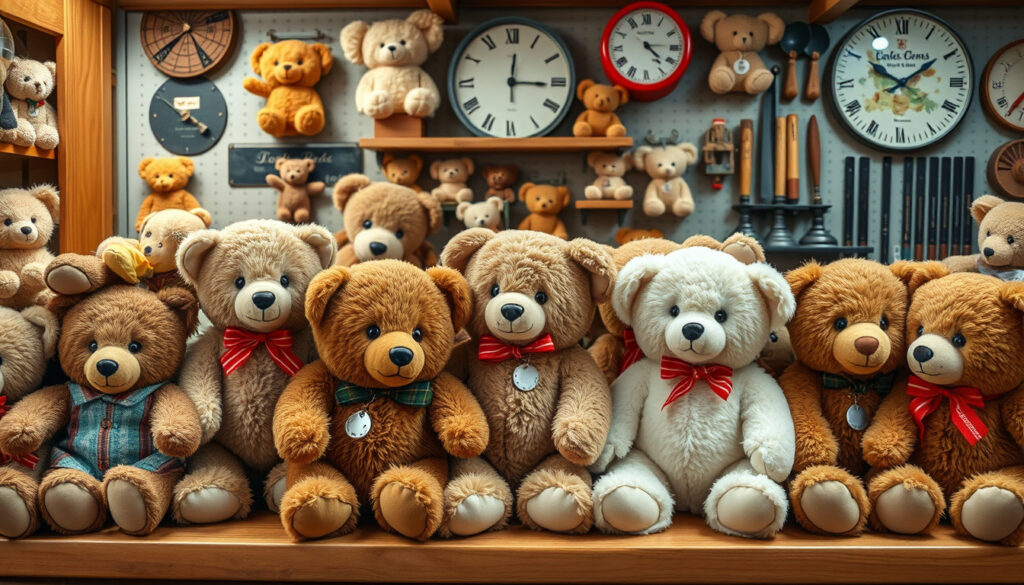
Teddy Bears: History, Best Brands, Cute Names & More
There’s a reason the teddy bear has outlasted nearly every other children’s toy: it carries a story that starts with a US president refusing to shoot a bear. This guide traces that 120-year journey, compares the best brands for Irish buyers, and answers the questions that keep popping up in searches—from why they’re called “teddy” to what to name your new companion.
Year first teddy bear sold: 1903 ·
Named after US President: Theodore Roosevelt ·
Oldest surviving teddy bear: 1904 Steiff bear ·
Most famous teddy bear: Winnie the Pooh ·
Number of Steiff bears made annually: Over 1 million
Quick snapshot
- Origin from 1902 cartoon (National Park Service)
- Named after President Roosevelt (Library of Congress)
- First bear by Morris Michtom (Carnegie Museum of Natural History)
- Steiff, Charlie Bears, Jellycat (Bear Essentials Ireland)
- Where to buy in Ireland — Smyths, specialist shops (Bear Essentials Ireland)
- Quality considerations: material, jointing, safety certs (Bear Essentials Ireland)
- Winnie the Pooh — iconic literary bear
- Paddington Bear — from Peru to London
- Teddy Ruxpin — 1980s animatronic storyteller
- Cool names for teddy bears
- Girl teddy bear names
- British vs Irish terms
Key historical facts about teddy bears are summarised below.
| Fact | Details |
|---|---|
| First teddy bear maker | Morris Michtom (USA) and Steiff (Germany) — Steiff corporate history |
| Year of first teddy bear | 1903 — HISTORY |
| Meaning of ‘teddy’ | From President Theodore ‘Teddy’ Roosevelt — Library of Congress |
| Oldest teddy bear in museum | Steiff bear from 1904 at the Teddy Bear Museum |
Why are they called teddy bears?
What event led to the name?
- On November 14, 1902, President Theodore Roosevelt refused to shoot a bear during a hunting trip near Onward, Mississippi — National Park Service
- Two days later, November 16, 1902, The Washington Post published a political cartoon by Clifford Berryman depicting the incident — National Park Service
- Brooklyn candy shop owners Morris and Rose Michtom saw the cartoon and created a stuffed toy bear they called “Teddy’s Bear,” displayed in their store window — Smithsonian Magazine
Who coined the term teddy bear?
Morris Michtom is credited with the first use of “Teddy’s Bear” after receiving permission from President Roosevelt to use his name. The popularity of the toy led Michtom to found the Ideal Toy Company — National Park Service. By late 1906, the name had condensed to “teddy bear” — Smithsonian Magazine.
Meanwhile, in Germany, Richard Steiff had designed a mohair toy bear called Bear 55PB in 1902 — Steiff corporate history. The Steiff bear debuted at a German toy fair in 1903, just as the American version was taking off — HISTORY.
The implication: what began as a political novelty became a global icon because two separate inventors, unaware of each other, launched nearly identical products within months. That near-simultaneous emergence gave the teddy bear a gravitational pull no single toy company could have manufactured.
Which brand of teddy bear is best?
What are top brands like Steiff, Charlie Bears, Jellycat?
Four brands dominate the Irish market, each with a distinct value proposition.
| Brand | Key Feature | Typical Price Range | Best For |
|---|---|---|---|
| Steiff | Button in ear, mohair, heirloom quality — Steiff corporate history | €50–€500+ | Collectors, gifts with long-term value |
| Charlie Bears | Hand-finished, limited editions — Bear Essentials Ireland | €60–€300 | Serious collectors, display pieces |
| Jellycat | Ultra-soft fabrics, washable, modern designs — Bear Essentials Ireland | €25–€80 | Children, babies, plush comfort |
| Moulin Roty | French design, vintage aesthetic, baby-safe — Bear Essentials Ireland | €30–€100 | Nursery, newborn gifts |
What features should I look for?
- Material: Mohair or alpaca for heirloom; polyester for washable kids’ bears.
- Construction: Fully jointed limbs allow poseability; non-jointed is safer for under-3s.
- Safety: Look for EN71 certification in Europe; Steiff and Jellycat explicitly test to standard — Toy Street.
- Washability: Jellycat bears are machine-washable; most collectible Steiff bears are surface-clean only.
The trade-off: a €30 Jellycat survives toddler slobber; a €300 Steiff demands respect. Irish buyers looking for a daily companion should prioritise washable fabrics; collectors should prioritise Steiff’s button-in-ear authentication.
Upsides
- Steiff bears hold resale value; some limited editions appreciate — Steiff corporate history
- Jellycat bears are machine-washable and baby-safe — Bear Essentials Ireland
- Charlie Bears offer artistic, hand-sculpted designs not found in mass-market brands
- Moulin Roty bears are designed for newborns with no small parts
Downsides
- Steiff pricing is prohibitive for casual buyers
- Charlie Bears limited runs mean availability can be unpredictable
- Jellycat bears lack the formal collectible certification of Steiff
- Moulin Roty designs are less common outside specialist shops
The pattern: premium brands trade on heirloom quality and resale value, while mass-market brands prioritise safety and washability — the buyer’s intent determines which set of trade-offs makes sense.
Where can I buy good quality teddies?
Online stores in Ireland
- Smyths Toys Ireland — Ireland’s largest toy chain; carries Jellycat and some Steiff starter bears. See also our guide on Custom T-Shirt Printing in Ireland for related gift-buying tips.
- Bear Essentials Ireland — Specialist retailer with the widest selection of Steiff, Charlie Bears, and Moulin Roty; they note they are currently retiring from market, so stock may be limited — Bear Essentials Ireland
- TheGiftShop.ie — Offers personalisation and a curated range of mid-tier bears.
- CottonPlanet.ie — Focuses on natural-fibre bears including organic cotton options.
Physical shops in Dublin and Cork
- Dublin: Smyths on the Long Mile Road and Liffey Valley carry Jellycat; smaller gift shops in Temple Bar stock artisan bears seasonally.
- Cork: Mahon Point Smyths has a dedicated plush section; independent toy shops around Paul Street offer curated selections.
What this means: for the Irish buyer, the online-first approach of most specialist retailers (like Bear Essentials and CottonPlanet) means geography is less limiting than it was a decade ago. The catch is that Bear Essentials’ retirement reduces the specialist supply; Smyths and TheGiftShop become the default for mid-range quality.
Who is the most famous teddy bear?
Winnie the Pooh
First appearing in A.A. Milne’s 1926 book, Winnie the Pooh is arguably the most widely recognised teddy bear in global culture — HISTORY. The original stuffed animals that inspired the stories reside at the New York Public Library.
Paddington Bear
Introduced in 1958 by Michael Bond, Paddington is a bear from Peru who arrives at London’s Paddington Station. He’s a distinct character but often grouped with teddy bears because of his plush, toy-like appearance — Smithsonian Magazine.
Teddy Ruxpin
The animatronic storytelling bear from the 1980s represents a different category: a technological teddy. While not a “cuddly toy” in the traditional sense, Teddy Ruxpin demonstrated the bear form’s adaptability to digital play.
The pattern: each famous bear reflects its era—Winnie the Pooh the gentle 1920s, Paddington the post-war immigrant story, Teddy Ruxpin the tech optimism of the 1980s. For Irish families, Paddington’s theme of a displaced bear finding a new home carries particular resonance in a country with a strong emigration history. For similar collectible character guides, see our My Little Pony Fluttershy Guide.
Timeline: Key dates in teddy bear history
- November 1902 — Political cartoon by Clifford Berryman shows Roosevelt refusing to shoot a bear — National Park Service
- 1903 — Morris Michtom creates first “Teddy’s Bear”; Steiff produces Bear 55PB with button in ear — HISTORY
- 1906 — The term “teddy bear” becomes widespread — Smithsonian Magazine
- 1920s–1930s — Teddy bears become staple children’s toy worldwide
- 1926 — Winnie the Pooh published by A.A. Milne
- 1958 — Paddington Bear introduced
Confirmed facts
- Teddy bear named after President Theodore Roosevelt — National Park Service
- First teddy bear sold by Morris Michtom in 1903 — HISTORY
- Steiff bears have button in ear — Steiff corporate history
What’s unclear
- Exact origin of the term ‘teddy’ before 1902
- Whether the first bear was made by Michtom or Steiff first — HISTORY notes both claims
- Whether Winnie the Pooh is definitively the most famous teddy bear (subjective ranking)
- Exact date the term “teddy bear” became widespread before 1906
- Whether the British market received teddy bears before the US market expanded
Expert perspectives
“The Teddy Bear was originally a political commentary joke—a candy store owner saw the cartoon and thought, ‘That would make a great toy.’ The permission from Roosevelt himself turned a passing joke into a historical artifact.”
— Morris Michtom (as recorded in historical accounts), via National Park Service
“The button in the ear is not just a logo—it is a guarantee that this bear meets the original Steiff standards of quality control. Every button has a specific year code that collectors can trace.”
— Steiff company historian, via Steiff corporate history
What is a cool name for a teddy bear?
What do you call a girl teddy bear?
- Classic names: Bella, Daisy, Rosie, Lily
- Literary names: Alice, Matilda, Eloise
- Nature-inspired: Willow, Clover, Hazel
- Irish names: Saoirse, Ciara, Aoife, Orla
What are cute nicknames for a bear?
- Descriptive: Snuggles, Fluffy, Cuddles, Button
- Food-themed: Biscuit, Cookie, Honey, Marshmallow
- Pop culture: Paddington, Winnie, Yogi, Baloo
- Irish terms: A chara (friend), Mo grá (my love), Enda (bird-like)
The pattern: Irish buyers increasingly choose names that reflect local identity—Saoirse ranks highly in online searches for girl teddy names. The catch: avoid names that sound too similar to common Irish dog names (like “Luna” or “Murphy”) if you plan to have both pets and teddies in the same household.
smithsonianmag.com, en.wikipedia.org, smithsonianmag.com, encyclopedia.com
Frequently asked questions
Are teddy bears safe for babies?
Only if they meet EN71 safety standards. Look for bears with embroidered eyes (not plastic) and no detachable parts. Jellycat and Steiff both produce newborn-safe lines — Toy Street. Avoid vintage bears for infants, as stuffing and eyes may not meet modern safety standards.
How to clean a teddy bear?
Check the label. Machine-washable bears (most Jellycat models) go in a pillowcase on a gentle 30°C cycle. Non-washable bears (most collectible Steiff and Charlie Bears) need spot-cleaning with a mild soap and damp cloth. Never dry-clean a vintage bear — the chemicals can degrade the mohair — Steiff corporate history.
What materials are teddy bears made of?
Traditional materials: mohair (from angora goat), alpaca wool, or synthetic plush (polyester). Steiff uses mohair for its flagship bears; Jellycat uses mostly polyester plush. For collectibles, mohair holds value best; for children, synthetic is easier to clean — Steiff corporate history.
Why are teddy bears given as gifts?
Because the bear carries a symbolic weight: it’s a comfort object that says “I will protect you” without words. The historical connection to Roosevelt’s mercy (refusing to shoot) adds an unconscious layer of kindness. In Ireland, teddies are especially popular for newborn presents and Christmas gifts.
Can I personalise a teddy bear?
Yes. TheGiftShop.ie offers embroidery services on select bears; Steiff has a limited personalisation programme for its bespoke line. Many independent Irish crafters on Etsy also offer personalised teddy bears with Irish names or Gaelic phrases.
How long do teddy bears last?
A well-made Steiff bear can last 50–100 years with proper care — the button-in-ear tradition ensures traceable provenance. Jellycat bears typically last 5–15 years with regular washing. The key variable: storage away from direct sunlight and humidity — Steiff corporate history.
What is the average cost of a good quality teddy bear?
In Ireland, €25–€50 buys a quality Jellycat; €60–€150 buys a mid-range Charlie Bear or entry-level Steiff; €200–€500+ buys a collectible Steiff or limited-edition Charlie Bear. For a gift that will be used daily, budget €30–€60; for a heirloom piece, budget €150+.
For Irish buyers, the choice is clear: if you want a daily companion for a child, get a Jellycat for its washability and safety certification. If you want an investment piece that can be passed down, buy a Steiff with the button in the ear. For a one-off gift that bridges both worlds, a mid-range Charlie Bear offers collectibility without the heirloom price tag. The teddy bear has survived 120 years because it adapts—but in 2025, the best decision is knowing which kind of lasting you’re aiming for.
More related posts
 Monique Wright: Biography, Husband, Children, and Net Worth
 Larsa Pippen: Kardashians, Marcus Jordan, Divorce & OnlyFans
 Phil Collins Health: Condition, Wheelchair, Partner & Latest News
 Catherine McClements: Career, Awards & Current Projects
 House of Guinness Reviews: 90% RT Score & Irish Backlash
 Joel Embiid: Injury, Wife, Height, Retirement Status
 City Beach Australia – Perth’s Closest Beach Guide
 Sai Baba: A Comprehensive Guide to the Saint of Shirdi