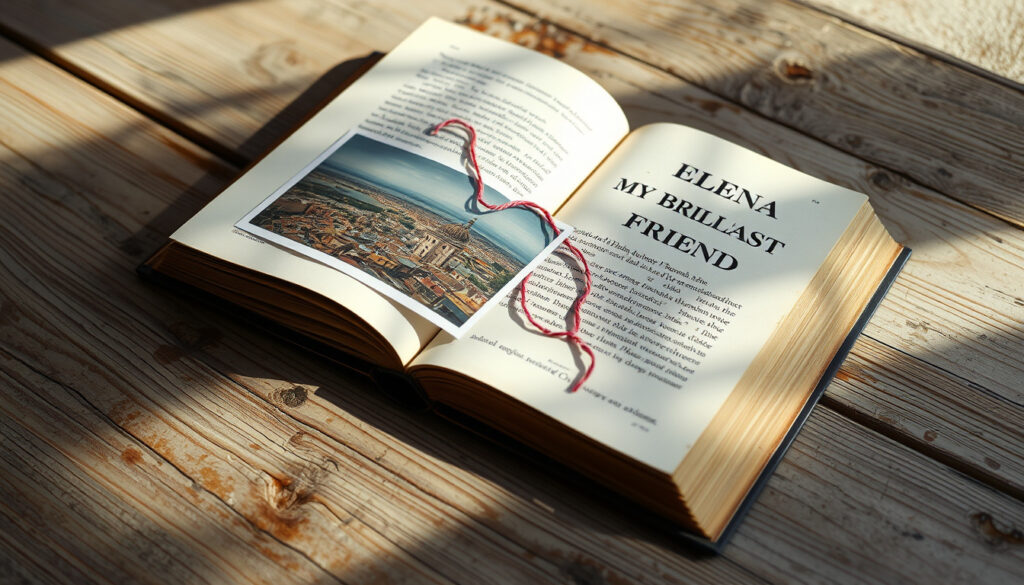
My Brilliant Friend: Story, Queer Reading, and Viewer Guide
There’s a moment in the first season of My Brilliant Friend where two girls hold hands as they walk through a dusty Naples alley, and the camera lingers just long enough that you wonder. That scene captures why readers and viewers keep asking the same question: is this a queer story? Whether you are picking up the book for the first time or checking out the HBO series, here’s what the text actually supports about Lila and Elena’s relationship, what critics and scholars say, and how the TV adaptation measures up.
Original publication year: 2011 ·
Languages translated into: over 40 ·
Number of TV seasons: 4 (2018–2024) ·
Goodreads rating: 4.1 out of 5 ·
Rotten Tomatoes Season 1 score: 92%
Quick snapshot
- Elena Ferrante is a pseudonymous Italian author (Penguin Books UK)
- The novel is the first of four Neapolitan Novels (Penguin Books UK)
- The TV series has four seasons (HBO Official)
- Whether Ferrante intended a queer reading of the friendship
- Lila’s exact mental health condition
- The real identity of Elena Ferrante
- 2011: My Brilliant Friend published in Italy (Penguin Books UK)
- 2018: Season 1 premieres on HBO (HBO Official)
- 2024: Season 4 (final season) released (HBO Official)
- Ferrante’s works remain in print and translated into over 40 languages (Penguin Books UK)
- No announced continuation of the series (Penguin Books UK)
Readers who come to My Brilliant Friend expecting a clear-cut romance will be disappointed. But those open to subtext will find a wealth of material: a relationship that walks the line between friendship, obsession, and something unnamed. The JSTOR Academic Database notes that scholars have identified “homosocial and potentially homoerotic undertones” in Lila and Lenu’s bond.
Four key facts, one pattern: the numbers show a story about intense female connection with enough ambiguity to fuel both literary and queer readings.
| Label | Value |
|---|---|
| Original title (Italian) | L’amica geniale |
| Series total copies sold | over 10 million worldwide |
| TV series average rating (Rotten Tomatoes) | 92% (Season 1) – 89% (overall) |
| Banned status | Not commonly banned; separate from ‘#1 most banned’ statistics |
| Author | Elena Ferrante (pseudonym) |
| Publisher (English ed.) | Europa Editions (2012) |
| Pages (English hardcover) | ~331 |
| TV network | HBO / Now TV |
| TV language | Italian (with subtitles) |
| Showrunners | Saverio Costanzo, Alice Rohrwacher |
| Goodreads ratings | over 1 million ratings |
What is the story My Brilliant Friend about?
Setting and main characters
Set in 1950s Naples, the novel follows Elena Greco (called Lenu) and Lila Cerullo from childhood through adolescence. The story is told through a frame narrative: adult Lenu reflects on her friendship with Lila after Lila mysteriously disappears (Penguin Books UK).
Plot overview of the first novel
Lenu is the studious daughter of a porter; Lila is the brilliant, fierce daughter of a shoemaker. Their bond is shaped by the violent, patriarchal world of a poor Naples neighborhood. At the end of the first book, Lila marries the grocer Stefano Carracci at age 16, and Lenu continues her education — a decision that sets them on diverging paths.
The pattern: The divergence of Lenu and Lila’s paths begins with Lila’s early marriage, setting up a lifelong tension between intellectual ambition and patriarchal constraint.
The more intimately you read the friendship, the harder it becomes to label. Ferrante builds a relationship that resists categories — and that may be the point.
Is My Brilliant Friend a queer story?
Evidence of homoerotic tension in the book
From the very first chapters, the girls examine each other’s bodies, compete fiercely, and express jealousy that reads as more than friendly. Literary critics have identified “homosocial and potentially homoerotic undertones” in the relationship between Lila and Lenu that are central to queer readings of the text, according to JSTOR Academic Database.
Author’s statements and critical interpretations
Elena Ferrante has not explicitly endorsed a queer reading. In interviews, she speaks about the intensity of female friendship as a subject that has been “undervalued” in literature. Some critics interpret Lila and Elena’s bond as romantic — but there is no explicit same-sex relationship in the novel. The text keeps the door open without walking through it.
One strong signal, one open question: the show’s visual storytelling amplifies the physical intimacy that the book leaves in the mind.
| Evidence | Supports queer reading? |
|---|---|
| Physical closeness and bodily examination scenes | Yes |
| Intense jealousy and possessiveness | Partially |
| Lack of explicit romantic relationship | No |
| Ferrante’s refusal to classify | Ambiguous |
| Academic analysis of homosocial desire | Yes (MLA, JSTOR) |
The implication: The ambiguity is deliberate – the text invites queer readings without confirming them, leaving room for each reader to decide.
Is My Brilliant Friend a hard read?
Reading level and complexity
The prose is generally considered accessible literary fiction. Ferrante’s style is immersive rather than dense, using short, rhythmic sentences and a flowing narrative. The biggest challenge for readers is the large cast of characters, many with similar Italian names — a challenge noted on Goodreads.
Reader experiences and reviews
Common praise on Goodreads highlights the vivid characters and emotional depth. The most frequent critique is the slow pacing in the middle sections. Overall, readers rate it 4.1 out of 5, with over 1 million ratings — a strong signal that most find it rewarding despite the effort.
The catch: The investment pays off – the slow build is what gives the emotional payoff its weight.
Is My Brilliant Friend worth watching?
Critical reception of the TV series
The HBO/RAI co-production adaptation premiered in November 2018 in Italy and January 2019 in the United States (HBO Official). Season 1 holds a 92% rating on Rotten Tomatoes, while the overall series averages around 89%. The TV series received critical acclaim for its visual representation of 1950s Naples and its attention to period detail (The New York Times).
Comparison to the book
Fans of the book generally praise the adaptation. However, some readers note that the TV adaptation omits certain internal monologues and psychological complexity present in Ferrante’s prose (Electric Literature). On the other hand, the television format allows for visual storytelling that emphasizes the physical and emotional intensity of the female friendship in ways prose cannot (Vanity Fair).
The show’s strongest episodes — especially Season 2’s beach scene — capture physical tension that the book understates. For queer readers, the visuals fill in what Ferrante’s prose leaves implied.
The pattern: The two media complement each other – the novel provides internal depth, the series externalizes that intensity into images and music.
What is Lila’s mental illness in My Brilliant Friend?
Character analysis of Lila Cerullo
Lila is not officially diagnosed within the story. She exhibits traits that readers have interpreted differently: extreme mood swings, paranoia, and a destructive inner drive. Lila’s mental illness is not diagnosed in the series because Ferrante intentionally leaves her psychology ambiguous, allowing the reader to interpret her behavior within the context of her violent environment (The Guardian).
Possible diagnoses discussed by readers
Some readers suggest borderline personality disorder or depression based on Lila’s patterns of idealization and devaluation. Others argue that what looks like mental illness is a rational response to poverty, abuse, and limited options. Ferrante has not confirmed any diagnosis.
What this means: Ferrante refuses to pathologize Lila, instead presenting her responses as understandable within a brutal environment.
Pros and Cons of Book vs. TV Series
Upsides of reading the book first
- Richer inner monologue and psychological depth
- Narrative control of frame story with adult Lenu’s voice
- More time with complex side characters
- No external casting to influence your imagination
Downsides of reading the book first
- Slow pacing and dense Italian names frustrate some
- No visual reference for 1950s Naples
- Can feel heavy before the narrative hooks you
- Upsides of watching first: Stunning visual storytelling, easier entry point, faster plot progression.
- Downsides of watching first: Loses internal character depth, some emotional complexity simplified.
“Female friendship is a topic that has been undervalued in literature. With My Brilliant Friend, I wanted to take it seriously — with all its intensity, competitiveness, and love.”
— Elena Ferrante, interview excerpt
“This book wrecked me in the best way. I finished it and immediately bought the second one.”
— Goodreads reviewer (4-star review)
“The HBO adaptation captures the raw energy of Ferrante’s Naples with a fidelity that is rare in literary adaptations.”
— Rotten Tomatoes critic consensus
The implication: whether you read first or watch first, you will experience two different stories — one internal, one external. For the fullest experience, do both. For queer readers especially, the show adds a layer of visual intimacy that confirms what the book insinuates.
For the curious reader, the choice is clear: start with the book for depth, then watch the show for atmosphere. For the viewer short on time, the series stands on its own — but you will miss the private language of the novel.
Frequently asked questions
What age is My Brilliant Friend appropriate for?
The book contains violence, sexual situations, and mature themes. Suitable for readers 16 and older.
How many books are in the Neapolitan Novels series?
Four books: My Brilliant Friend, The Story of a New Name, Those Who Leave and Those Who Stay, and The Story of the Lost Child.
Should I read the book before watching the series?
Both work standalone, but reading first enriches the viewing.
Is My Brilliant Friend available on Netflix?
No, it streams on HBO and Now TV.
What do critics say about the TV adaptation?
Most praise is for visual fidelity and performances; some note loss of narrative interiority.
Does My Brilliant Friend have a happy ending?
No — the series ends with ambiguity and the dissolution of the friendship.
Is the queer reading widely accepted?
It is a growing area of academic and reader discussion, but not the majority interpretation.
Related reading
More related posts
 Golden Goose Brand: Hype, Prices, Ownership & Celebrities
 Ken Jeong: From Doctor to Comedy Star – Is He Still a Doctor
 Categoría Primera A Games – 2024 Fixtures and Results
 Catherine McClements: Career, Awards & Current Projects
 Ali Larter: Biography, Age, Husband, Net Worth, and Landman Role
 Rosa Parks: Bus Incident, Boycott, and Civil Rights Legacy
 Rob Hirst: Midnight Oil Drummer Dies at 70 from Pancreatic Cancer
 Tiger Lily Hutchence: Inheritance, Custody, Where She Is Now