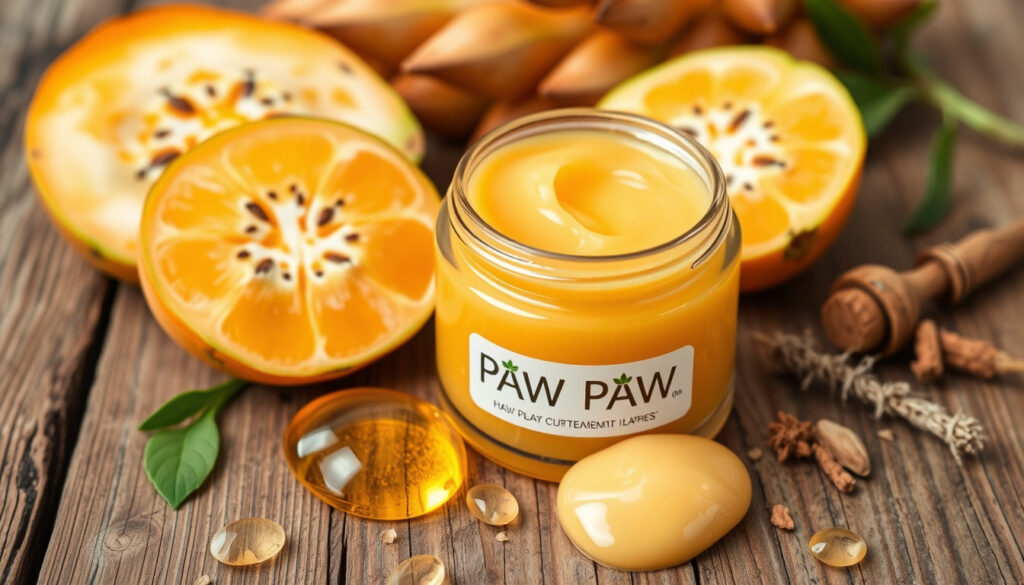
Paw Paw Ointment: Uses, Benefits, Safety & Ingredients
If you’ve ever watched someone’s face light up at the mention of a certain amber-coloured jar, you know this product inspires loyalty. Paw paw ointment — specifically the Lucas Papaw formula — has occupied bathroom cabinets across Australia for over a century, and its reputation now stretches worldwide. This guide cuts through the hype: what it actually contains, what it genuinely helps with, and what questions you should ask before slathering it on.
Key Ingredient: Australian Carica Papaya (39mg/g) ·
Invented: 1906 by Dr. T.P. Lucas ·
Official Uses: Lips, dry skin, minor wounds
Quick snapshot
- Papaya-based formula with 39mg/g active ingredient from Queensland-grown fruit (Lucas’ Papaw Remedies Official Ingredients Page)
- Petroleum jelly carrier meets US FDA and European Pharmacopeia standards (Lucas’ Papaw Remedies Official Ingredients Page)
- Registered as AUST L 13397 with Australia’s Therapeutic Goods Administration (TGA Official Recall Notice)
- How effective papaya enzymes are compared to clinical wound treatments
- Whether all regional versions match Australia’s exact formulation
- Full outcomes from registered ANZCTR clinical trial on wound healing
- 1906: Dr. T.P. Lucas develops original formulation (ANZCTR Clinical Trial Registry)
- 1989: American Academy of Dermatology affirms petroleum jelly safety (Lucas’ Papaw Remedies Safety Debunking Page)
- 2011: Peer-reviewed study flags trace allergen in product (PubMed / Australasian Journal of Dermatology)
- ANZCTR trial may clarify wound healing efficacy claims once results are published
- TGA continues oversight as product gains international popularity
A snapshot of product attributes and regulatory status provides context for the detailed analysis that follows.
| Attribute | Detail |
|---|---|
| Primary Ingredient | Pure Australian Carica Papaya |
| Active Concentration | 39mg/g fermented papaya |
| Inventor | Dr. T.P. Lucas (1906 formulation) |
| Form | Ointment balm |
| Carrier Base | Pharmaceutical petroleum jelly |
| Target Areas | Lips, dry skin, minor wounds |
| Preservative | Potassium sorbate (0.1 mg/g) |
| Registration | AUST L 13397 |
What is paw paw ointment good for?
The original Lucas Papaw formula was developed in Australia in 1906 by surgeon and botanist Dr. T.P. Lucas, who sought to harness the healing properties of fermented papaya for medical use. Today, the ointment occupies a unique position as a multi-purpose skin product — neither purely medicinal nor purely cosmetic.
Uses for lips and dry skin
- Relieving dry, chapped lips and skin while improving texture (Lucas’ Papaw Remedies Official Benefits Page)
- Treating cracked hands, cuticles, and nail areas (Nourished Life AU Lifestyle Blog)
- Acting as a protective barrier against moisture — useful for nappy rash in babies (Lucas’ Papaw Remedies Official Benefits Page)
Application on minor irritations
- Minor cuts and scratches — the petroleum jelly carrier seals the wound from airborne bacteria while holding the active ingredient in place (Lucas’ Papaw Remedies Official Safety Debunking Page)
- Sports injuries: chafing, grazes, and abrasions benefit from both the barrier function and soothing papaya enzymes (Lucas’ Papaw Remedies Official Benefits Page)
- Insect bites, splinters, and minor burns — the ointment is officially listed for these uses by the manufacturer (Lucas’ Papaw Remedies Official Safety Debunking Page)
The formula’s versatility stems from its two-part mechanism: petroleum jelly creates an occlusive seal, while fermented papaya provides enzymes that may assist with debridement — breaking down dead tissue on wounds.
What are the benefits of paw paw cream?
Beyond basic moisturizing, the Lucas Papaw formula offers specific skin benefits tied to its ingredient profile. Understanding what’s actually in the jar helps separate fact from folklore.
Moisturizing effects
- Petrolatum acts as an emollient, smoothing skin texture and restoring the barrier function (INCIDecoder Ingredient Database)
- The American Academy of Dermatology confirmed in 1989 that petroleum jelly is non-comedogenic and does not cause allergic reactions — addressing a common concern about occlusive products (Lucas’ Papaw Remedies Safety Debunking Page)
- Beeswax adds additional emollient and emulsifying properties to the blend (INCIDecoder Ingredient Database)
Soothing properties
- The papain enzyme from fermented papaya may reduce redness and swelling in irritated skin — a benefit tied to papaya’s enzymatic activity on skin proteins (Simply Clare Blog Analysis)
- A peer-reviewed study found papaya-based ointments with papain-urea superior to collagenase for reducing wound size in hard-to-heal sloughy wounds over 4 weeks — suggesting genuine therapeutic potential beyond basic moisture (Cambridge Media Journals Clinical Study)
- The fermentation process concentrates enzymes from hundreds of papaws per batch, giving the product higher enzyme activity than fresh papaya alone (Lucas’ Papaw Remedies Official Safety Debunking Page)
The implication: users who see faster healing on minor wounds aren’t just imagining it — there is biological plausibility, though the magnitude of effect compared to clinical treatments remains under study.
Petrolatum-based products are widely available for a fraction of the price. For purely moisturizing purposes, plain petroleum jelly performs comparably — the papaya enzymes add the therapeutic edge.
What are the disadvantages of pawpaw cream?
No product is universally perfect. Examining the limitations — and the documented risks — helps readers make informed choices rather than relying on community testimonials alone.
Potential limitations
- Regional variations exist: Singapore-listed ingredients reportedly include glycerine, which the Australian manufacturer explicitly excludes from their formulation (Raffles Health Singapore Product Listing)
- Certain batch sizes (15g, 75g, 200g) have been recalled by Australia’s TGA due to microbial contamination, including Aspergillus tubingensis and other organisms — though this is a quality control issue, not a formula flaw (TGA Official Recall Notice)
- For purely cosmetic moisturizing, cheaper alternatives like plain petroleum jelly or specialised lip balms may serve equally well
Safety concerns
- Two patients experienced allergic contact dermatitis and cheilitis linked to trace amounts of Myroxylon pereirae (Balsam of Peru) — a substance not listed on the label (PubMed / Australasian Journal of Dermatology Peer-Reviewed Research)
- The study authors noted the manufacturer confirmed a small amount of this allergen was present, even though it didn’t appear in the ingredient list — raising questions about supply chain transparency (PubMed / Australasian Journal of Dermatology Peer-Reviewed Research)
- Anyone with known fragrance allergies or sensitivities to Balsam of Peru should exercise caution before using this product
The pattern: the advantages are real, but so are the documented risks — and both deserve mention rather than selective emphasis.
The TGA has issued recalls for microbial contamination, not formulation irregularities. Purchasers should verify batch integrity, especially for the affected sizes (15g, 75g, 200g).
Can I put paw paw ointment on an open wound?
This is one of the most frequently searched questions about the product, and the answer requires separating official manufacturer guidance from actual evidence.
Wound care guidelines
- The manufacturer lists minor cuts and scratches among the official uses, stating the petroleum jelly carrier seals wounds from bacteria while holding the fermented papaya in contact with the wound bed (Lucas’ Papaw Remedies Official Safety Debunking Page)
- Dr. Lucas’ original rationale was precisely this: petroleum jelly seals wounds from airborne bacteria and holds the active ingredient in place (Lucas’ Papaw Remedies Official Safety Debunking Page)
- A clinical trial is registered with Australia’s ANZCTR to test wound healing efficacy — indicating the therapeutic claim is serious enough to warrant formal investigation (ANZCTR Clinical Trial Registry)
Risks involved
- Deep puncture wounds, heavily infected wounds, or animal bites should receive professional medical evaluation before applying any topical product
- The TGA recall involved microbial contamination in certain batches — applying potentially contaminated product to an open wound would be counterproductive
- The Balsam of Peru allergen risk is heightened with broken skin, as absorption is greater
The implication: for minor cuts, grazes, and abrasions, the product has a defensible rationale. For anything beyond superficial skin disruption, a healthcare provider’s assessment takes priority.
Does pawpaw cream have steroids?
The steroid question surfaces repeatedly in online discussions — often fueled by how effectively the product reduces inflammation on irritated skin. Here’s what the evidence actually shows.
Ingredient analysis
- The Australian manufacturer explicitly states the formula does not contain polyplasdone, talc, shellac, palm oil, glycerin, polyvinylpyrrolidone (PVP), or sodium lauryl sulphate (SLS) (Lucas’ Papaw Remedies Official Ingredients Page)
- Ingredients include: pharmaceutical petroleum jelly, canola oil, hydrogenated castor oil, beeswax, corn starch, fermented Carica Papaya (39mg/g), and potassium sorbate (0.1 mg/g) as preservative (INCIDecoder Ingredient Database)
- No corticosteroid compounds appear on any verified ingredient list — and steroids are typically listed explicitly in formulations because of their pharmaceutical classification
Formulation details
- Petroleum jelly is non-comedogenic, non-carcinogenic, and does not cause allergic reactions per the American Academy of Dermatology’s 1989 ruling (Lucas’ Papaw Remedies Safety Debunking Page)
- What some users perceive as steroid-like effects (rapid reduction in redness and swelling) may stem from papain enzyme activity, which breaks down proteins and may reduce inflammatory mediators in the skin
- The product is registered as AUST L 13397 — a listing that would be revoked if undeclared pharmaceutical actives were present (TGA Official Recall Notice)
What this means: the anti-inflammatory effect is genuine, but it comes from papaya enzymes — specifically papain — not from corticosteroids. If you’re avoiding steroids for a specific medical reason, this product does not contain them.
Allergen risk exists even for ingredients not listed on the label. Patch testing on a small skin area before widespread use remains the safest approach for anyone with sensitive skin.
Evidence comparisons across different products help calibrate expectations for what each formulation can deliver.
| Product | Active Mechanism | Primary Use | Evidence Level |
|---|---|---|---|
| Lucas Papaw Ointment | Fermented papaya (39mg/g) + petroleum jelly barrier | Multi-purpose: lips, dry skin, minor wounds | Manufacturer claims + one clinical trial registered |
| Plain Petroleum Jelly | Occlusive barrier only | Moisturizing, wound protection | American Academy of Dermatology confirmation (1989) |
| Papain-Urea Ointment | Papain + urea (clinical formulation) | Debridement of hard-to-heal wounds | Peer-reviewed superiority trial over 4 weeks |
Three products, three tiers of evidence: plain petroleum jelly has the longest safety record with regulatory backing, papaya-based ointments occupy the middle ground with growing clinical interest, and clinical papain-urea formulations have demonstrated superiority in controlled settings.
Understanding each ingredient’s role clarifies how the formula achieves its effects.
| Ingredient | Function | Source/Standard |
|---|---|---|
| Fermented Carica Papaya | Active ingredient (39mg/g) | Queensland-grown fresh fruit |
| Petroleum Jelly | Carrier base, occlusive barrier | Pharmaceutical grade (US FDA, Eur. Pharm.) |
| Canola Oil | Emollient | Food-grade |
| Hydrogenated Castor Oil | Thickener, stabiliser | Standard cosmetic grade |
| Beeswax | Emollient, viscosity control | Natural source |
| Corn Starch | Texture modifier | Food-grade |
| Potassium Sorbate | Preservative (0.1 mg/g) | Approved food/cosmetic preservative |
Seven ingredients form the complete formula — a relatively short list that excludes common irritants like palm oil, glycerin, and SLS. The absence of these reduces the risk of certain skin reactions.
Upsides
- Over a century of use with established safety profile
- Multi-purpose functionality covers three common needs
- Registered with TGA (AUST L 13397)
- No undeclared pharmaceutical actives
- Relatively short ingredient list without common irritants
- Clinical trial underway to verify wound healing claims
Downsides
- Trace Balsam of Peru allergen not on label (documented dermatitis cases)
- TGA recall history for microbial contamination in certain batches
- Regional formulation variations possible
- More expensive than plain petroleum jelly for basic moisturizing
- Long-term independent efficacy data still accumulating
- ANZCTR clinical trial results not yet published
“Produced to Dr T.P Lucas’ formulation, every ingredient in Lucas’ Papaw Ointment is stringently reviewed for quality, effectiveness and necessity.”
— Lucas’ Papaw Remedies (Manufacturer, official ingredient page)
“MP was not listed as an ingredient in LPO, however the manufacturer confirmed that a small amount of MP was present in LPO and we believe this to be the cause of the patients’ dermatitis.”
— Australas J Dermatol (Peer-reviewed research, 2011)
For anyone with fragrance sensitivity or a history of contact dermatitis, the Balsam of Peru issue deserves attention before first use. A patch test on a small skin area remains the safest approach.
For buyers in Australia, the TGA registration provides regulatory reassurance — and the recall history shows the system does catch quality issues when they arise. International purchasers face a slightly different calculus: regional variations in formulation and the absence of TGA oversight mean due diligence on batch sourcing matters.
The trade-off is straightforward: Lucas Papaw Ointment offers genuine multi-purpose utility backed by a century of use and emerging clinical interest, but it is not a substitute for medical treatment of significant wounds, and documented allergy risks remain. Choose it for what it demonstrably does — moisturising, barrier protection, and minor wound care — rather than what marketing mythology assigns to a brown glass jar.
Related reading: Murrumba Downs Medical Centre: Hours, Phone, Address, Booking · Woolworths Deception Bay: Hours, Address, Phone & Guide
Frequently asked questions
What are the main ingredients in paw paw ointment?
The Australian Lucas Papaw formula contains fermented Carica Papaya (39mg/g as the active ingredient), pharmaceutical petroleum jelly as the carrier, canola oil, hydrogenated castor oil, beeswax, corn starch, and potassium sorbate (0.1 mg/g) as preservative.
Is paw paw ointment natural?
It contains natural papaya enzymes from a fermentation process, but also pharmaceutical-grade petroleum jelly — which is a petroleum derivative, not a natural botanical. The blend straddles the natural/conventional boundary depending on how strictly you define “natural.”
Where can I buy paw paw ointment?
In Australia, it is widely available at pharmacies, supermarkets, and health food stores. Internationally, it is stocked by health retailers and online marketplaces. Verify the batch number and check for any active recalls before purchase.
Is paw paw ointment good for lips?
Yes — relieving dry, chapped lips is among the official uses listed by the manufacturer. The petroleum jelly provides occlusion while papaya enzymes may soothe irritation.
What is the difference between real paw paw ointment and Lucas Papaw?
Lucas Papaw is the original 1906 Dr. T.P. Lucas formula, registered as AUST L 13397 in Australia. Generic “paw paw ointments” may use different formulations, concentrations, or quality standards. The papaya concentration (39mg/g) and fermentation process are specific to Lucas’ Papaw Remedies.
Does paw paw ointment work on burns?
The manufacturer lists minor burns and sunburn among official uses. The petroleum jelly barrier protects damaged skin while the papaya enzymes may assist with healing. Deep or serious burns require medical attention, not home treatment.
Is paw paw ointment safe for babies?
The manufacturer lists nappy rash treatment as an official use and the formula avoids common baby-skin irritants like talc and SLS. However, the trace Balsam of Peru issue warrants caution for babies with sensitive skin — a patch test first is advisable.
Does paw paw ointment contain steroids?
No verified ingredient list shows any corticosteroid compound. The anti-inflammatory effect users notice comes from papain enzyme activity, not steroids. The product is registered with TGA, which would detect undeclared pharmaceutical actives.
More related posts
 Smart Watches 2026: Best Picks, Buying Guide & Expert Tips
 Murrumba Downs Medical Centre: Hours, Phone, Address, Booking
 Maria Sakkari’s Comeback: Coaching Reunion & Ranking
 Samuel Johnson: Biography, Dictionary, Quotes & Facts
 Carrie Coon Biography: Age, Husband, Movies & TV Shows
 Cliff Burton Death: Bus Crash, Last Words, Royalties
 Dani Daniels Career Profile and Life Story
 Paint and Sip Ireland: Dublin, Galway, Limerick Guide