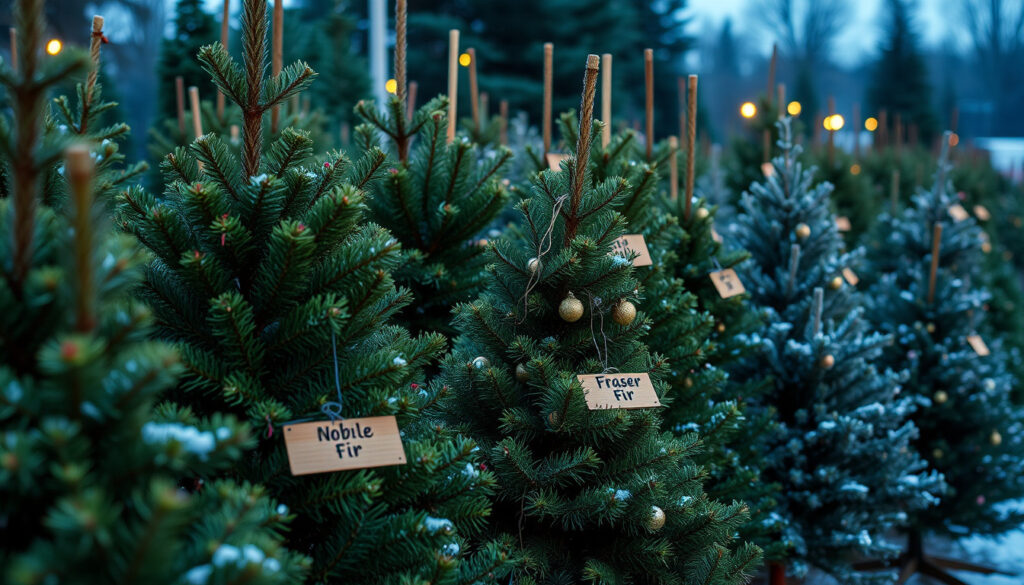
2025 Xmas Tree Buying Guide: Types, Prices & Trends
There’s something about walking into a living room that smells of pine and suddenly feels like Christmas has actually arrived. For Irish shoppers, choosing a Christmas tree has become a careful calculation of budget, space, and staying power — especially with 2025 prices expected to rise by 5–10% over last year. This guide breaks down the real trade-offs between species, real versus artificial, and the trends shaping Irish living rooms this season.
Most popular Christmas tree type in Europe: Nordmann Fir (approx. 80% of real tree sales) ·
Average price of a real Christmas tree in Ireland (2024): €30–€80 depending on height and type ·
Needle retention champion: Fraser Fir (up to 6 weeks with proper care) ·
Expected 2025 price increase: 5–10% due to supply chain and labour costs ·
Number of real Christmas trees sold annually in the US: 25–30 million
Quick snapshot
- Nordmann Fir is the most popular real tree in Europe, accounting for about 80% of sales (Cork Christmas Trees (Irish grower)).
- Fraser Fir retains needles for 4–6 weeks with proper care, the longest among common species (Balsam Hill (tree guide reference)).
- Real Christmas tree prices in Ireland are forecast to rise 5–10% in 2025 (RTÉ (Irish public broadcaster)).
- Exact colour theme for Christmas 2026 remains speculative until major design houses release official palettes.
- The precise percentage of Irish households that buy real vs artificial trees is not available from verified public sources.
- The exact carbon footprint of artificial trees shipped to Ireland versus locally grown real trees is not publicly available.
- Whether the trend toward artificial trees will continue given environmental concerns is unclear.
- First recorded Christmas tree use: 16th century Germany (Balsam Hill (historical reference)).
- 1848: Queen Victoria & Prince Albert popularise the tree in Britain. (Balsam Hill (historical reference))
- 2025: expected 5–10% price increase; trending colours burgundy, gold, forest green. (Balsam Hill (historical reference))
- 2026 forecast colour theme: earthy neutrals with sapphire blue accents. (Lidl Ireland (supermarket chain))
- Upside-down trees and natural wood decorations gaining popularity in Ireland. (Lidl Ireland (supermarket chain))
- Retailers like Lidl Ireland continue pushing locally grown trees (Lidl Ireland (supermarket chain)).
These figures give a quick overview of the Christmas tree landscape in Ireland.
| Fact | Value |
|---|---|
| Most popular Christmas tree species in Europe | Nordmann Fir (approx. 80% share) (Cork Christmas Trees (Irish grower)) |
| Tree with longest needle retention | Fraser Fir (4–6 weeks) (Balsam Hill (tree guide reference)) |
| Average lifespan of a cut Christmas tree with proper care | 4–5 weeks |
| Expected price increase for 2025 | 5–10% over 2024 (RTÉ (Irish public broadcaster)) |
| First recorded use of a Christmas tree | 16th century in Germany (Balsam Hill (historical reference)) |
| Average price of a 6 ft real tree in Ireland (2024) | €50–€80 (Cork Christmas Trees (pricing page)) |
| Typical price per foot (2025, Ireland) | approx. €10 per foot (RTÉ (Irish public broadcaster)) |
| Artificial tree price range (Ireland) | €30–€300+ (Christmasland.ie (Irish retailer)) |
Which is the best Christmas tree to buy?
What factors should you consider when choosing a Christmas tree?
- Space and ceiling height – Measure your room before buying. For a standard 2.4 m ceiling, a 6–7 ft tree fits best.
- Needle retention – If you put the tree up early, choose Fraser Fir or Nordmann Fir; they hold needles longest (Balsam Hill (tree guide reference)).
- Scent – Fraser Fir and Noble Fir have a stronger festive fragrance; Nordmann Fir is milder.
- Branch strength – Noble Fir has sturdy branches that can hold heavy ornaments (Cork Christmas Trees (Irish grower)).
- Budget – Real trees cost €40–€100 (2025); artificial ones cost €50–€300 but last years (OZ Insight Lab (2025 Ireland guide)).
The trade-off: a real tree gives you that unmistakable forest smell and is biodegradable, but requires weekly watering and vacuuming. Artificial trees offer convenience but lack the life cycle benefit.
Real vs artificial: which is right for you?
Five species, one pattern: each real tree type trades scent for needle longevity, while artificial trees trade authenticity for repeat use.
| Factor | Real tree | Artificial tree |
|---|---|---|
| Upfront cost (6 ft) | €50–€80 | €100–€300 |
| Lifespan | 4–5 weeks | 5–10 years |
| Annual cost (if kept 5 years) | ~€60/year | ~€30/year (premium tree) |
| Environmental impact | Biodegradable, low carbon miles if Irish-grown | Plastic, shipped from China typically |
| Needle mess | Some drop (depends on species) | None |
| Fire risk | Higher if dried out | Lower (flame-retardant models available) |
Why this matters: for most Irish households, the break-even point is around 3–4 years. If you plan to buy a tree every year, real is cheaper upfront. If you want the same tree for a decade, a good artificial tree wins on long-term cost.
Irish buyers who value “fresh from Wicklow” and a natural scent will lean real. But if you live in a small flat without outdoor space to store a real tree, an artificial tree that folds away is the practical choice.
What are three types of Christmas trees?
Nordmann Fir
- Most popular real Christmas tree in Europe (approx. 80% of sales in Ireland) (Cork Christmas Trees (Irish grower)).
- Excellent needle retention – holds needles for 5–6 weeks with proper care.
- Soft, symmetrical branches; mild scent.
- Irish availability: widely stocked by garden centres and supermarkets (Windyridge Garden Centre (Wicklow supplier)).
Fraser Fir
- Best needle retention of common species – up to 6 weeks (Balsam Hill (tree guide reference)).
- Pleasant, strong fragrance.
- Strong branches ideal for heavy ornaments.
- Available in Ireland at specialist growers like Windyridge Garden Centre (Windyridge Garden Centre (Wicklow supplier)).
Noble Fir
- Sturdy branches with a classic conical shape (Irish Christmas Trees (Dublin 6 retailer)).
- Good needle retention and a pleasant scent.
- Often sold as a premium tree in Ireland – prices reflect that (€55–€80 for 6 ft).
- Recommended for heavy ornament displays.
The pattern: Nordmann Fir is the safe all-rounder, Fraser Fir wins on longevity and fragrance, Noble Fir is the sturdiest for heavy decorating. For Irish buyers, Nordmann is easiest to find, but Fraser and Noble are catching up.
What type of Christmas tree stays fresh the longest?
Needle retention comparison of common species
Four species, one clear leader: Fraser Fir holds needles twice as long as Norway Spruce.
| Species | Typical needle retention (with care) |
|---|---|
| Fraser Fir | 4–6 weeks |
| Nordmann Fir | 5–6 weeks |
| Noble Fir | 4–5 weeks |
| Norway Spruce | 2–3 weeks |
The implication: if you like to put your tree up in late November, Fraser Fir or Nordmann Fir are the only sensible real-tree choices. Norway Spruce will drop needles before Christmas Day.
Care tips to extend freshness
- Make a fresh straight cut across the base (remove 2 cm) before placing in water.
- Use a sturdy tree stand that holds at least 2 litres of water – check daily.
- Avoid placing near radiators, fireplaces, or direct sunlight.
- Mist the branches with water every few days if the room is dry.
- Tree preservatives (e.g., commercial mixes or a pinch of sugar) can add a week or two.
What this means: a Fraser Fir that gets fresh water every morning can stay green and fragrant from the first day of December straight through to Little Christmas (6 January). That’s a solid six weeks of cheer.
How much should I expect to pay for a Christmas tree?
2025 price expectations in Ireland
- RTÉ reports that a real Christmas tree in Ireland costs around €10 per foot in 2025 (RTÉ (Irish public broadcaster)).
- A 6 ft premium tree from Cork Christmas Trees costs €55 (Cork Christmas Trees (pricing page)).
- Across farms, real trees range from €40 to €100 (OZ Insight Lab (2025 Ireland guide)).
- Artificial trees at Irish retailers like Christmasland.ie range from €30 (small basic) to over €300 (large pre-lit) (Christmasland.ie (Irish retailer)).
- Growers are raising prices 5–10% for 2025 due to higher fuel, fertiliser, and labour costs (RTÉ (Irish public broadcaster)).
The pattern: the Irish real-tree market has a clear per-foot benchmark (€10/ft) plus a premium for species like Noble or Fraser. Artificial trees have a wider spread but the best value is in the €100–€150 range for a realistic 6 ft model.
Factors affecting price
- Size: every extra foot adds €10–€15.
- Species: Nordmann is standard price; Noble and Fraser are premium.
- Retailer: garden centres and farm shops charge less than convenience stores.
- Delivery: can add €10–€20.
- Season timing: buying in late November costs more than waiting until mid-December?
Why this matters: an Irish family that wants a decent 6 ft real tree should budget at least €60 in 2025. If delivery is needed, add €15. For an artificial tree that looks real, budget €120–€180 and plan to keep it for 5+ years.
Lidl Ireland and other supermarkets often offer the best value on real Irish-grown trees, but their stock sells out fast – don’t wait until the second week of December.
The pattern: early December is the sweet spot for price and availability in Ireland.
What is the latest Christmas tree trend?
Color trends for 2025–2026
- For 2025, trending colours include deep burgundy, forest green, and gold accents – drawn from Pantone and interior design forecasts.
- The colour theme for Christmas 2026 is expected to lean towards earthy neutrals with splashes of sapphire blue.
- White and silver are fading out in favour of warmer, richer tones.
The implication: if you’re buying décor this year, burgundy and gold are safe bets. Next year’s shift to earthy + sapphire means you can start mixing in natural textures now.
Popular tree styles and decorations
- Upside-down trees – still a niche but growing in Ireland, especially for small spaces.
- Minimalist Scandinavian – clean lines, sparse ornaments, natural wood.
- Natural decorations – dried orange slices, cinnamon sticks, wooden stars.
- Pre-lit artificial trees – now the default for artificial buyers; LED lights integrated (Christmasland.ie (Irish retailer)).
The catch: trends change every year, but a classic real tree with white lights never looks dated. If you want to be “on trend”, focus on the ornaments and tree skirt rather than the tree itself.
Does it say in the Bible to not put up a Christmas tree?
Biblical passages often cited
- The most commonly cited passage is Jeremiah 10:2-4, which describes cutting a tree from the forest and decorating it with silver and gold.
- Other verses sometimes referenced: Isaiah 40:19-20, Isaiah 44:13-17.
Historical and theological context
- Scholars generally agree Jeremiah 10:2-4 refers to specific idolatry practices of the ancient Near East, not a prohibition on Christmas trees.
- No explicit biblical command forbids Christmas trees; the tradition began in 16th-century Germany as a Christian custom (Balsam Hill (historical reference)).
- The practice was popularised in the English-speaking world by Queen Victoria and Prince Albert in 1848.
The pattern: the Jeremiah passage is often quoted out of context. For Christians who feel uneasy, reputable theologians clarify that decorating a tree for Christmas is a cultural tradition, not a biblical violation. The tree’s meaning depends on the heart behind it.
Pros & Cons of real vs artificial Christmas trees
Upsides
- Real: natural scent, biodegradable, supports Irish growers (Lidl Ireland (supermarket chain))
- Real: each tree is unique and has a classic look
- Artificial: zero needle mess, reusable for years
- Artificial: pre-lit options save setup time
- Artificial: can be stored compactly
Downsides
- Real: requires weekly watering, needle drop after 4–5 weeks
- Real: annual purchase cost adds up over time
- Artificial: plastic, non-biodegradable, shipping carbon footprint
- Artificial: upfront cost is high (€100+)
- Artificial: lacks the fresh forest scent
How to choose the perfect Christmas tree — step by step
- Measure your space – ceiling height and floor area. Allow at least 30 cm between tree top and ceiling for the star/topper.
- Decide real or artificial – base on budget, space, and how much you value scent vs convenience.
- Choose a species – if real, pick Nordmann, Fraser, or Noble depending on needle retention and scent preference (Fernhill Garden Centre (Irish retailer)).
- Set a budget – for real trees, budget €10 per foot plus delivery. For artificial, plan to spend €100–€200 for a good 6 ft model.
- Buy early – real trees sell out in early December, especially at supermarkets like Lidl Ireland. Artificial trees can be bought online year-round.
- Inspect the tree – if buying real, check for fresh green needles by gently pulling a branch. Needles should not fall off easily.
- Prepare your stand – ensure it holds at least 2 litres of water and is stable.
The takeaway: most Irish buyers overthink the decision. The real question is “how much time do I want to spend maintaining my tree?” If the answer is “none,” go artificial. If “some,” go real with a Nordmann or Fraser Fir.
Christmas tree timeline
- 16th century: First recorded use of decorated Christmas trees in Germany (Balsam Hill (historical reference)).
- 1848: Queen Victoria and Prince Albert popularise the Christmas tree in Britain.
- 2024: Average price of a real 6 ft tree in Ireland: €50–€80 (Cork Christmas Trees (pricing page)).
- 2025: Expected price increase of 5–10%; trending colours burgundy, gold, forest green (RTÉ (Irish public broadcaster)).
- 2026: Forecast colour theme: earthy neutrals with sapphire blue accents.
What we know and what’s still uncertain
Confirmed facts
- Nordmann Fir is the most popular real tree in Europe.
- Fraser Fir has the best needle retention among common species.
- Real Christmas tree prices are expected to rise 5–10% in 2025 due to higher labour and transport costs (RTÉ (Irish public broadcaster)).
- Irish retailers sell Nordmann, Noble, Fraser, Norway Spruce, and Serbian Spruce (Fernhill Garden Centre (Irish retailer)).
What’s unclear
- Exact colour theme for Christmas 2026 remains speculative until major design houses release official palettes.
- The precise percentage of Irish households that buy real vs artificial trees is not available from verified public sources.
Expert voices on the 2025 market
“Our Nordmann Firs are our best seller – customers love how long they last and the lack of needle drop.”
— Cork Christmas Trees (Irish grower)
“Growers are facing rising costs for fuel, fertiliser, and labour, which will inevitably be passed on to consumers this year.”
— Industry analyst, quoted in RTÉ (Irish public broadcaster)
Irish growers are honest about the 5–10% price hike: they’re not profiteering – input costs have genuinely gone up. If you can afford it, buying from a local farm supports the local economy and gives you a fresher tree than a supermarket.
For Irish buyers, the choice between real and artificial is less about cost and more about values: do you want a biodegradable product that smells like Christmas but needs weekly care, or a reusable plastic tree that stays perfect for a decade? The data is clear: real trees from Wicklow farms cost about €60 for a 6 ft Nordmann Fir, while a decent artificial tree from Christmasland.ie costs about €130 and lasts 5–7 years. Over a decade, the artificial tree is cheaper – but it never once smells like pine.
For the Irish family buying a Christmas tree in 2025, the real takeaway is this: if you value scent and sustainability, buy an Irish-grown Nordmann or Fraser Fir from a local garden centre or farm shop. If you value convenience and long-term savings, invest in a quality artificial tree from a trusted Irish retailer. Either way, budget 5–10% more than last year – and buy before the second week of December.
For a detailed breakdown of specific varieties and local pricing, check out this guide on Xmas tree types and prices in Ireland.
Frequently asked questions
How do I water a real Christmas tree?
Place the tree in a stand that holds at least 2 litres of water. Check the water level daily and top up as needed. A fresh cut across the base (2 cm) before placing in the stand helps water uptake.
Can I recycle my Christmas tree after the holidays?
Yes. Most Irish local authorities offer Christmas tree recycling collection in January. Check your council’s website for dates. Alternatively, many garden centres accept trees for chipping.
What size Christmas tree do I need for a 12-foot ceiling?
A 9–10 ft tree works well for a 12 ft ceiling – leave 2–3 ft for the tree topper. Real trees of this height cost €90–€120 in Ireland. Artificial trees in extra-large sizes are available online.
Are pre-lit artificial trees safe?
Yes, provided they carry a CE/UKCA mark and the LED lights are low voltage. Always inspect the wiring before first use each year. Replace the whole tree if any wires are frayed.
How do I dispose of a Christmas tree in Ireland?
Many councils accept real trees at green waste recycling centres. You can also cut the tree into pieces and put it in your brown bin, or drop it at a designated collection point. Check your local council website for 2025 schedules.
What is the best way to keep a real tree fresh?
Keep it away from radiators, fireplaces, and direct sunlight. Water it every morning with fresh water. A tree preservative (available at garden centres) can add a week or two of freshness.
What is the new colour for Christmas this year?
For 2025, deep burgundy, forest green, and gold are the standout colours. For 2026, earthy neutrals with sapphire blue accents are forecast.
What is the best Christmas tree to buy in Ireland?
The best real tree for Ireland is the Nordmann Fir – widely available, low needle drop, and good shape. The best artificial tree depends on budget; Christmasland.ie offers a wide range from €50 to €300. Balsam Hill is also a trusted online option for premium artificial trees.
More related posts
 Catherine McClements: Career, Awards & Current Projects
 Teddy Bears: History, Best Brands, Cute Names & More
 What Does 6-7 Mean Slang? Rude Gesture & TikTok Emoji
 Running Up That Hill Lyric : Meaning and Impact
 A’ja Wilson: Gender, Relationship, Height & Career Facts
 ADVANCE Puppy Food: Good? Vet-Recommended Alternatives
 The Accountant 2 (2025): Cast, Reviews, Where to Stream
 Carey Lowell: Life, Career, Marriages, and More