iPad Air 11 Inch – Specs, Price and Pro Comparison
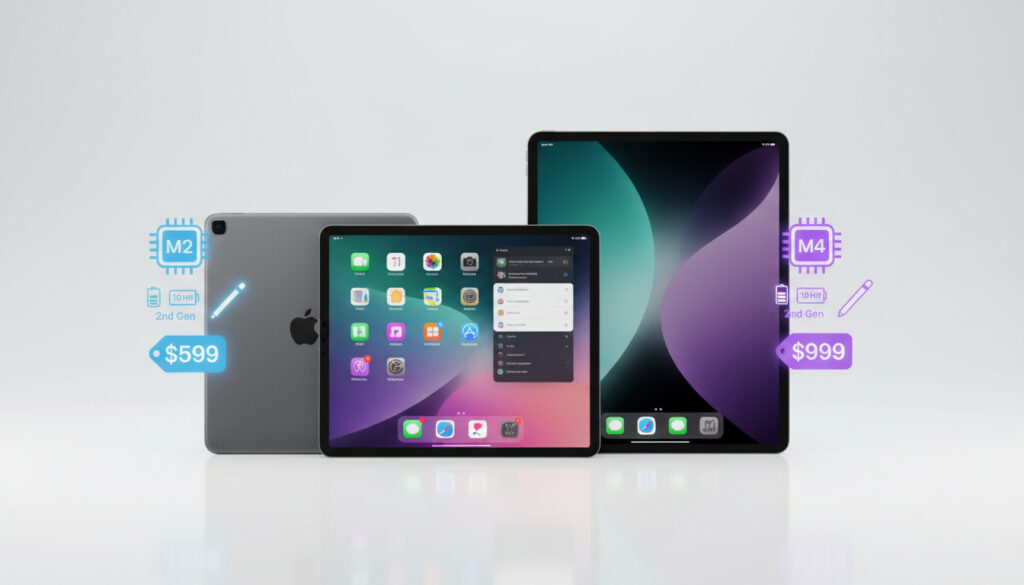
The 11-inch iPad Air (M2, 2024) delivers desktop-class processing in a 462-gram chassis, bridging the gap between entry-level tablets and the professional iPad Pro lineup. Released in May 2024, this generation doubles the base storage to 128GB while maintaining a $599 starting price, positioning it as the primary choice for students and mobile professionals seeking high-performance hardware without OLED premium pricing.
Apple’s M2 chip powers the device, offering measurable performance improvements over its M1 predecessor. The tablet supports the Apple Pencil Pro and Magic Keyboard, enabling full laptop replacement workflows despite the absence of ProMotion display technology or Face ID authentication. Four color options—Blue, Purple, Starlight, and Space Gray—provide aesthetic variety alongside the technical specifications.
Positioned against both the larger 13-inch iPad Air and the M4 iPad Pro, the 11-inch model optimizes for portability. The 10.86-inch Liquid Retina display maintains compatibility with existing accessory ecosystems while the landscape-oriented front camera improves video conferencing ergonomics.
What Are the Key Specs of the 11-Inch iPad Air?
$599
Apple M2
11-inch Liquid Retina
May 2024
- M2 chip delivers 15% faster CPU and 25% faster GPU performance compared to the previous M1 generation
- Base storage configuration doubled to 128GB from the prior 64GB standard at the same entry price
- Full compatibility with Apple Pencil Pro, including squeeze gestures and barrel roll detection
- Landscape-oriented 12MP front camera with Center Stage optimization for video conferencing
- Battery rated for 10 hours of Wi-Fi web browsing or video playback
- Wi-Fi 6E and Bluetooth 5.3 connectivity standards
- Touch ID integrated into the power button; no Face ID hardware
| Specification | Details |
|---|---|
| Display | 10.86-inch (11-inch marketed) Liquid Retina IPS LCD, 2360×1640 resolution, 264 ppi, 500 nits brightness, P3 wide color, True Tone, 60Hz refresh rate |
| Chip | Apple M2 (8-core CPU with 4 performance and 4 efficiency cores up to 3.49 GHz, 9-core GPU, 16-core Neural Engine, 8GB RAM) |
| Storage | 128GB, 256GB, 512GB, or 1TB NAND flash |
| Battery | Up to 10 hours web/video; ~7,607 mAh capacity |
| Cameras | 12MP rear Wide (4K video); 12MP front Ultra Wide landscape (1080p, Center Stage) |
| Colors | Blue, Purple, Starlight, Space Gray |
| Connectivity | Wi-Fi 6E, Bluetooth 5.3, USB-C port |
| Dimensions | 247.6 × 178.5 × 6.1 mm, 462g weight |
| Biometric | Touch ID integrated into power button |
| Audio | Dual landscape stereo speakers, dual microphones |
Display and Design
The 10.86-inch LED-backlit Liquid Retina display presents content at 2360×1640 resolution with 264 pixels per inch. Technical specifications confirm 500 nits maximum brightness, P3 wide color gamut coverage, and True Tone ambient color temperature adjustment. The fully laminated panel includes antireflective and oleophobic coatings.
The 60Hz refresh rate distinguishes this model from Pro-tier devices. Apple’s official documentation verifies the absence of ProMotion technology, meaning the display does not dynamically adjust refresh rates up to 120Hz. Touch ID biometric authentication resides within the power button rather than utilizing Face ID facial recognition.
Performance and Chip
Apple’s M2 system-on-a-chip provides the computational foundation. The 8-core CPU divides between four performance cores and four efficiency cores, reaching peak speeds up to 3.49 GHz. A 9-core GPU handles graphics rendering alongside a 16-core Neural Engine for machine learning tasks. The configuration includes 8GB of unified memory with 100 GB/s memory bandwidth.
Hardware acceleration supports professional media codecs including H.264, HEVC, ProRes, and Dolby Vision. Benchmark testing confirms the M2 delivers approximately 50% faster overall performance compared to the previous M1-based iPad Air, with specific gains of 15% for CPU-bound tasks and 25% for GPU-intensive operations.
Cameras and Audio
The rear 12-megapixel Wide camera captures 4K video at 60 frames per second. The front-facing 12-megapixel Ultra Wide camera adopts a landscape orientation, positioning the lens optimally for video conferencing when the device rests in keyboard cases. Center Stage technology automatically adjusts framing to keep subjects visible during calls.
Audio output flows through dual landscape stereo speakers positioned to provide stereo separation in horizontal orientation. Dual microphones support audio recording and noise reduction for video conferencing environments.
How Much Does the 11-Inch iPad Air Cost and Is It Worth It?
Pricing by Configuration
Wi-Fi-only models start at $599 for the 128GB configuration. The 256GB variant costs $699, while 512GB storage commands $899. The maximum 1TB configuration retails for $1,099. Cellular connectivity adds approximately $150 to each respective storage tier, though exact pricing varies by regional carrier and taxation.
The 128GB base model accommodates streaming-dominant workflows and cloud-based document storage. Users editing 4K video locally or maintaining extensive offline media libraries should evaluate the 512GB or 1TB configurations to avoid storage management constraints.
Value Proposition
The 2024 generation improves value by doubling base storage without increasing entry pricing. Accessory compatibility extends functionality; the device supports the Apple Pencil Pro with squeeze gestures and barrel roll detection, alongside the Magic Keyboard for laptop-style productivity. These capabilities position the device between casual tablets and professional workstations.
For students and mobile professionals, the M2 chip provides sufficient processing power for document editing, illustration, and light video production. The absence of ProMotion and Face ID represents the primary compromises compared to the iPad Pro, though neither limitation impacts standard productivity workflows significantly.
iPad Air 11-Inch vs iPad Pro 11-Inch: Key Differences
Display and Performance
The iPad Pro 11-inch (M4) utilizes Tandem OLED technology delivering 1000+ nits brightness and 120Hz ProMotion adaptive refresh rates. The iPad Air maintains a 60Hz LCD panel capped at 500 nits. The Pro’s M4 chip includes ray tracing hardware and 12GB+ unified memory, compared to the Air’s M2 with 8GB RAM.
Content creators requiring OLED color accuracy for HDR workflows or 120Hz smoothness for animation timing should select the iPad Pro. The Air’s LCD panel serves general productivity and media consumption adequately but lacks the contrast and motion clarity of OLED technology.
Price and Features
The iPad Pro commands approximately $400 premium over the Air’s $599 starting price. Beyond display and processor advantages, the Pro offers Face ID authentication, Thunderbolt/USB 4 connectivity, and storage options extending to 2TB. The Air utilizes Touch ID and standard USB-C, capping storage at 1TB.
Both devices support the Apple Pencil Pro and Magic Keyboard accessories. Official specifications confirm weight differences; the Pro weighs approximately 444g versus the Air’s 462g, despite the Pro’s more advanced display technology.
iPad Air 11-Inch vs 13-Inch: Size Comparison
Portability vs Screen Real Estate
The 11-inch model measures 247.6 × 178.5 × 6.1 mm and weighs 462g. The 13-inch variant expands the display while increasing weight to 677g—215 grams heavier. The larger model offers increased display area for multitasking and media, though one-handed operation becomes impractical.
Both models share identical M2 chip specifications and 8GB RAM allocations. The 13-inch display achieves 600 nits maximum brightness compared to 500 nits on the 11-inch, though both utilize 60Hz LCD technology without ProMotion.
Battery and Price Impact
Despite physical differences, both models claim identical 10-hour battery life ratings for Wi-Fi web browsing or video playback. Technical analysis reveals the 11-inch contains a ~7,607 mAh battery while the 13-inch houses ~10,758 mAh; efficiency scaling maintains comparable endurance despite the capacity disparity.
The 13-inch model sacrifices one-handed usability and adds significant bag weight for marginal battery advantages. Mobile professionals prioritizing airplane tray table usage or standing operation should default to the 11-inch variant unless stationary desk work dominates usage patterns. For those looking to experiment with creative visuals, you can find an AI photo generator free no signup at $AI photo generator free no signup.
Pricing separates the siblings by $200; the 13-inch starts at $799 for 128GB versus $599 for the 11-inch equivalent. Both offer identical color options and accessory compatibility.
When Was the 11-Inch iPad Air Released?
- : Apple introduces the fourth-generation iPad Air featuring a 10.9-inch display and A14 Bionic chip, establishing the modern Air design language.
- : The fifth-generation Air debuts with the M1 chip, bringing Pro-level processing to the Air lineup for the first time.
- : Apple announces the M2-powered 11-inch and 13-inch iPad Air models, simultaneously updating the accessory ecosystem to support Apple Pencil Pro.
- : Retail availability begins shortly after announcement, with units shipping pre-loaded with iPadOS 17.
What Specifications Are Confirmed vs Uncertain?
| Established Information | Information That Remains Uncertain |
|---|---|
| M2 chip performance verified by independent benchmarks showing 15% CPU and 25% GPU improvements over M1 | Long-term battery degradation rates under sustained thermal loads vary by individual usage patterns |
| Official compatibility with Apple Pencil Pro and Magic Keyboard confirmed through Apple technical documentation | Timeline for next-generation hardware featuring OLED displays remains speculative with 2026 rumors unconfirmed |
| Battery capacity of ~7,607 mAh documented in regulatory filings and teardown analysis | Regional pricing fluctuations beyond suggested retail prices depend on local taxation and import duties |
| Starting price of $599 maintained from previous generation with base storage doubled to 128GB | Future iPadOS feature availability beyond current supported versions remains unannounced |
How Does the iPad Air Fit Within Apple’s Product Strategy?
The 11-inch iPad Air occupies the middle tier of Apple’s tablet hierarchy, inheriting processing capabilities from previous-generation Pro models while maintaining price accessibility. It targets the “prosumer” demographic—users requiring advanced multitasking and creative application performance without professional video production or color grading requirements.
This positioning parallels market segmentation strategies seen in other industries. Similar to how the Toyota Tundra Australia – Prices, Specs & Availability 2025 targets specific utility requirements within the automotive market, the iPad Air addresses computational portability needs distinct from both budget consumption devices and professional mobile workstations.
The device competes indirectly with entry-level laptops, offering touchscreen and stylus input advantages over traditional clamshell designs. For users prioritizing digital illustration, note-taking, or tablet-first workflows, the Air provides sufficient performance while avoiding the $999+ investment required for Pro-tier features rarely utilized by general consumers.
What Do Reviews and Official Sources Say?
“Liquid Retina display… up to 10 hours battery.”
Apple Inc., Technical Specifications
“Excellent value for M2 power… handles 99% of tasks reliably into 2025.”
PhoneArena Review Analysis
Final Assessment: Should You Buy the 11-Inch iPad Air?
The 11-inch iPad Air M2 represents the optimal balance of processing capability, portability, and price for students, mobile professionals, and casual creatives. It delivers sufficient performance for document editing, digital illustration, and media consumption without the premium cost of OLED displays or Face ID systems. Buyers requiring 120Hz refresh rates for professional animation or HDR color grading should select the iPad Pro, while those prioritizing screen size over portability should consider the 13-inch Air. For most users in 2025, the 128GB configuration provides adequate storage, particularly when paired with cloud services. As with purchasing decisions regarding the Walking Pad Kmart – Availability, Prices and Reviews Guide, buyers should evaluate primary use cases against technical specifications to determine appropriate investment levels.
Frequently Asked Questions
When was the 11-inch iPad Air released?
Apple announced the device on May 7, 2024, with retail availability beginning shortly thereafter in major markets.
Does the 11-inch iPad Air support Apple Pencil Pro?
Yes, the device supports Apple Pencil Pro features including squeeze gestures, barrel roll, haptic feedback, and magnetic charging.
What colors are available?
Apple offers four finishes: Blue, Purple, Starlight (warm gray), and Space Gray.
How does the battery compare to the 13-inch model?
Both models claim 10 hours of Wi-Fi web browsing or video playback, though the 11-inch utilizes a ~7,607 mAh battery compared to the 13-inch’s ~10,758 mAh.
Is Face ID available on the iPad Air?
No, biometric authentication relies on Touch ID integrated into the power button rather than Face ID facial recognition.
Can I use the Magic Keyboard with this iPad?
Yes, the landscape-oriented front camera optimizes the device for use with the Magic Keyboard and similar accessories.
What is the display refresh rate?
The Liquid Retina display operates at 60Hz and does not include ProMotion adaptive refresh rate technology.
How much does the cellular model cost?
Cellular connectivity adds approximately $150 to the Wi-Fi-only price for each storage configuration.
More related posts
 Rosa Parks: Bus Incident, Boycott, and Civil Rights Legacy
 Andrew Hastie: Biography, Controversies and Beliefs
 Prince Edward: A Complete Guide to the Royal Namesakes
 How to Book Cheap Hotels in Ireland: Top Tips & Sites
 A Simple Favor 2 – Release Date, Cast, Plot and Reviews
 Best Ensalada con Palta Near Me: Avocado Salad Guide & Recipes
 Shane Jacobson: Family, Net Worth, and Pub Purchase
 Henry Ford: Biography, Inventions, Assembly Line & Legacy