Mungo Man: 40,000-Year-Old Remains That Rewrote History
Few archaeological discoveries in Australia carry the weight of a single skeleton found on the shores of a dried-up lake. When geologist Jim Bowler stumbled upon the remains of a man at Lake Mungo in 1974, he had uncovered evidence of one of the world’s oldest known ritual burials — a discovery that would reshape our understanding of ancient human migration and ignite a decades-long campaign for the return of ancestral remains.
Age of remains: Approximately 40,000 years old ·
Estimated height: 170 cm (5 feet 7 inches) ·
Year discovered: 1974 ·
Year of repatriation: 2017 ·
Place of discovery: Lake Mungo, New South Wales ·
Sex: Male
Quick snapshot
- 40,000-year-old skeletal remains of an Aboriginal man (The Guardian)
- Discovered at Lake Mungo in New South Wales in 1974 (Wikipedia)
- One of the oldest known ritual burials in the world (Indigenous.gov.au)
- Exact height varies across sources (170 cm to 196 cm); most reliable says 170 cm (Humanities Australia)
- Whether Mungo Man and Mungo Lady are related is unknown (Humanities Australia)
- Precise cause of death remains uncertain — no trauma found (Humanities Australia)
- Remains stored at Mungo National Park keeping place pending final burial decisions (The Guardian)
- Ongoing discussions with traditional custodians about permanent resting place
Eight key facts about Mungo Man, from his physical traits to the status of his remains today:
| Attribute | Detail |
|---|---|
| Age | ~40,000 years old (The Guardian) |
| Height | 170 cm (5’7″) (Humanities Australia) |
| Discovery Year | 1974 (Wikipedia) |
| Repatriation Year | 2017 (Indigenous.gov.au) |
| Burial Location | Lake Mungo, NSW (Indigenous.gov.au) |
| Arthritis | Yes, osteoarthritis (Wikipedia) |
| Neanderthal DNA | No (Wikipedia) |
| Burial Goods | Red ochre (The Guardian) |
Who is Mungo Man and why is he important?
Mungo Man — catalogued as LM3 — is the skeleton of an Aboriginal man who lived during the Pleistocene epoch, roughly 40,000 years ago. His remains were discovered by geologist Jim Bowler on the shores of Lake Mungo in western New South Wales in 1974 (The Guardian). Alongside Mungo Lady (LM1), found in 1969, these are the oldest known human remains in Australia and represent the earliest evidence of ritual burial anywhere in the world.
How old is Mungo Man?
Multiple dating methods place Mungo Man at approximately 40,000 years old, with some estimates from the Australian Government Indigenous portal citing 42,000 years (Indigenous.gov.au). The range reflects the difficulty of dating ancient bone in the Willandra Lakes’ shifting dune systems. Sediment analysis and radiocarbon dating have been used, with results consistently pointing to a late Pleistocene age.
- Optically stimulated luminescence dating of surrounding sand gives a date of ~40,000 years (Wikipedia)
- Radiocarbon dating of shell fragments near the burial site supports the same range (BBC News)
Mungo Man pushes the accepted date of human occupation in Australia back by tens of thousands of years. For the Paakantji, Ngiyampaa, and Mutthi Mutthi peoples, his antiquity confirms what oral tradition has always held: that they have been custodians of this land since time immemorial.
What is the significance of Mungo Lady?
Mungo Lady (LM1) was discovered in 1969 — five years before Mungo Man — and her remains were also cremated and buried in a ritual ceremony on the same ancient lake shore. She is the oldest known cremation in the world (Wikipedia). Together, the two individuals represent a cultural and scientific landmark: they show that complex burial practices existed in Australia 40,000 years ago, at least as early as any known in Europe or Africa.
Where is Mungo Man today?
Mungo Man’s remains spent more than four decades in institutional storage before being returned to Country. The journey home was a milestone in Australian repatriation history.
Where were the remains found?
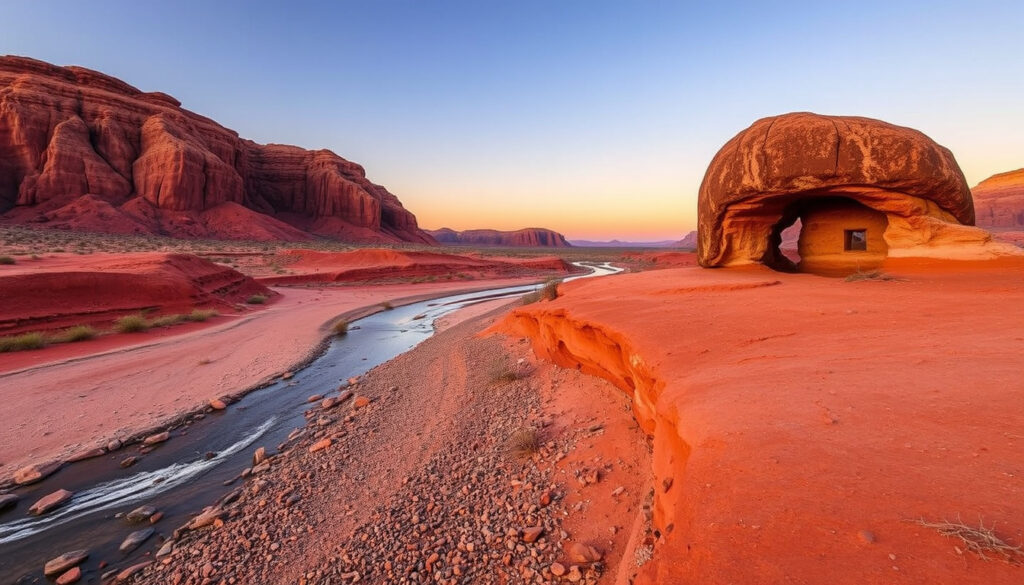
The skeleton was discovered eroding out of a lunette — a crescent-shaped dune — on the eastern shore of Lake Mungo, part of the Willandra Lakes World Heritage Area in New South Wales (Indigenous.gov.au). The site is now protected within Mungo National Park, a landscape of dry lake beds and wind-sculpted dunes that holds some of the world’s most significant Pleistocene archaeological deposits.
When and how was Mungo Man repatriated?
After being held at the Australian National University for decades, Mungo Man was returned to his ancestral lands in November 2017. The repatriation was a three-day, 800-kilometre procession in a restored vintage Chrysler Valiant hearse, with the casket built from 8,000-year-old river timber (The Guardian). Traditional smoking ceremonies were held at Welcome to Country stops in Hay and Balranald along the way (The Age).
- Mungo Man was accompanied by 103 other ancestral remains in the same procession (BBC News)
- A public ceremony was held at the Mungo lake shore on 17 November 2017 (Landscape Australia)
- Mungo Lady had been returned earlier, in 1991–92 (The Guardian)
What this means: the repatriation of Mungo Man is one of the most significant returns of ancestral remains in Australian history, and it set a precedent for the return of Indigenous cultural heritage held by institutions worldwide.
How tall was Mungo Man in feet?
Mungo Man’s height is estimated at 170 centimetres, or 5 feet 7 inches, based on analysis of his long bones (Humanities Australia). Some sources give figures as high as 196 cm, but the 170 cm measurement comes from the most detailed osteological study and is the one cited by the Australian Academy of the Humanities.
Did Mungo Man have arthritis?
Yes. The skeleton shows clear signs of osteoarthritis, particularly in the right elbow, wrist, and shoulder — consistent with repetitive, high-impact movements such as throwing spears or hunting with woomeras (Wikipedia). Professor Colin Pardoe, a bioarchaeologist who studied the remains, has noted that the pattern of arthritis is typical of a hunter-gatherer lifestyle in the Pleistocene.
Were aborigines typically tall?
Height estimates for ancient Aboriginal people vary considerably. Mungo Man’s stature of 170 cm falls within the middle range for pre-colonial Aboriginal men. Archaeological evidence from other sites such as Kow Swamp and Willandra Lakes shows heights ranging from 160 cm to 190 cm, suggesting that body size varied widely across different regions and time periods (Wikipedia).
The pattern: Mungo Man was not unusually tall or short for his time — his most remarkable features are not his height but the cultural evidence his burial provides.
Does Mungo Man have Neanderthal DNA?
No. Genetic studies have found no Neanderthal ancestry in Mungo Man. His DNA belongs to the ancient Aboriginal Australian lineage, which diverged from other human populations around 50,000 to 70,000 years ago (Wikipedia). This finding is consistent with the Out-of-Africa migration model: modern humans reached Australia via coastal routes across South Asia, and they did not interbreed with Neanderthals — a species that never inhabited the continent.
What is the genetic lineage of Mungo Man?
Mungo Man belongs to mitochondrial haplogroup S, a lineage unique to Aboriginal Australians. His genetic profile is most closely related to that of contemporary Indigenous Australians from the Willandra Lakes region (BBC News).
- No Neanderthal or Denisovan DNA has been detected in the Mungo remains (Wikipedia)
- His lineage is one of the oldest continuous human lineages outside Africa (BBC News)
The absence of Neanderthal DNA in Mungo Man supports the coastal migration theory, but it also means that the genetic history of Australia’s first peoples is harder to trace through admixture — the story must be read from the Aboriginal genome alone, without the cross-referencing that Eurasian populations offer.
The genetic evidence reinforces the distinctiveness of Aboriginal Australian ancestry, separate from other human lineages.
What happened to Mungo Man when he died?
Mungo Man was buried in a carefully conducted ceremony on the shores of Lake Mungo. His body was sprinkled with red ochre — a mineral pigment that was likely traded from distant sources — indicating that his community performed a ritual of some significance (The Guardian).
What was buried with Mungo Man?
Red ochre is the only burial good that has been conclusively identified with Mungo Man. The ochre was applied to his body in a powdered form, a practice that required significant effort — ochre had to be sourced, ground, and transported. This is one of the earliest known examples of ochre use in a funerary context anywhere in the world (Indigenous.gov.au).
How old was Mungo Man when he died?
Based on analysis of his teeth and skeletal development, Mungo Man was about 50 years old at the time of death (Wikipedia). That age would have made him an elder in his community — a man who had lived through decades of hunting, gathering, and ceremony in the harsh but resource-rich landscape of the Pleistocene Willandra Lakes system.
The catch: no cause of death has been determined. There is no evidence of trauma or violence on the bones, and the osteoarthritis he suffered was chronic, not fatal. It is possible he died of natural causes, but the archaeological record is silent on the precise reason.
Timeline: Mungo Man from burial to repatriation
- ~40,000 years ago — Mungo Man is buried on the shores of Lake Mungo in a ritual ceremony with red ochre (Indigenous.gov.au)
- 1969 — Mungo Lady (LM1) is discovered at Lake Mungo (Wikipedia)
- 1974 — Mungo Man (LM3) is discovered by geologist Jim Bowler (The Guardian)
- 1970s–2017 — Remains held at the Australian National University (BBC News)
- 2017 — Mungo Man is repatriated and returned to the Willandra Lakes region in a three-day ceremony (Indigenous.gov.au)
- 2018 — Remains placed in a keeping place at Mungo National Park (The Guardian)
The timeline demonstrates the long journey from burial to return, spanning millennia of custodianship and decades of advocacy.
What we know and what remains unclear
Confirmed facts
- Mungo Man is ~40,000 years old — consistent across multiple dating methods (Indigenous.gov.au)
- His burial included red ochre sprinkling (The Guardian)
- Repatriation occurred in 2017 after decades of campaigning (The Guardian)
- He had osteoarthritis in his right arm and shoulder (Wikipedia)
- No Neanderthal DNA has been found in his remains (Wikipedia)
What’s unclear
- Exact height: sources vary between 170 cm and 196 cm; the most reliable source gives 170 cm (Humanities Australia)
- Whether Mungo Man and Mungo Lady are related
- Precise cause of death — no trauma found, possibly natural causes
- Some sources indicate Mungo Man’s remains were held at the National Museum of Australia rather than ANU (The Age)
- The exact number of other ancestors repatriated with Mungo Man varies between 103 and more than 100 (BBC News, The Guardian)
These distinctions help readers separate established knowledge from ongoing questions in Mungo Man research.
Voices on Mungo Man
“The return of Mungo Man is a symbol of healing. It’s about bringing our ancestor home so that his spirit can rest.”
— Traditional custodians of the Paakantji, Ngiyampaa, and Mutthi Mutthi peoples (Indigenous.gov.au)
“The arthritis in Mungo Man’s right arm tells us he was a hunter — he threw spears, probably with a woomera, for decades. That’s the kind of life he lived.”
— Professor Colin Pardoe, bioarchaeologist (Wikipedia)
“When I first saw the remains eroding out of the dune, I knew I had found something extraordinary. But I never imagined the journey this discovery would take — both for science and for the Aboriginal community.”
— Jim Bowler, geologist and discoverer of Mungo Man (The Guardian)
The voices of scientists and custodians together provide a fuller picture of Mungo Man’s significance.
Mungo Man is not just a scientific specimen — he is a person with a name, a community, and a story that spans 40,000 years. His return to Country in 2017 was a moment of reckoning for Australian archaeology, a recognition that the study of ancient remains must be conducted with the consent and leadership of the people whose ancestors they are. For the Paakantji, Ngiyampaa, and Mutthi Mutthi custodians, the work is not finished: the question of where Mungo Man will finally be laid to rest remains open. The choice is clear: either a permanent keeping place on Country that honours his cultural significance, or continued storage that delays the closure his community has sought for decades.
ebsco.com, en.wikipedia.org, smithsonianmag.com, digital-classroom.nma.gov.au, landscapeaustralia.com, sbs.com.au, johnhawks.net, sbs.com.au
For a deeper look at the ongoing cultural significance of these remains, read about Mungo Mans repatriation journey.
Frequently asked questions
Why are Mungo Man and Mungo Lady important?
They are the oldest known human remains in Australia and represent the earliest evidence of ritual burial anywhere in the world. Their discovery reshaped the timeline of human migration to Australia and confirmed deep Aboriginal connection to the land.
How were the Lake Mungo remains discovered?
Mungo Lady was found in 1969 by a University of Melbourne team. Mungo Man was discovered in 1974 by geologist Jim Bowler, who spotted bones eroding from a dune on the shores of Lake Mungo.
What is the Willandra Lakes Region?
A UNESCO World Heritage Area in western New South Wales that contains a series of ancient lake beds, dunes, and archaeological sites spanning 50,000 years of human occupation (BBC News).
How old are the Lake Mungo remains?
Mungo Man is approximately 40,000 years old, with some estimates reaching 42,000 years. Mungo Lady is of a similar age (Indigenous.gov.au).
Who discovered Mungo Man?
Geologist Jim Bowler, while surveying the Lake Mungo lunette in 1974 (The Guardian).
What is red ochre and why was it used in burials?
Red ochre is a natural iron oxide pigment. Its use in burials suggests ritual significance — possibly representing blood, life, or the connection between the deceased and the land.
How does Mungo Man contribute to understanding human migration to Australia?
His DNA and age support the Out-of-Africa migration model, showing that humans reached Australia by at least 40,000 years ago via coastal routes through South Asia and Southeast Asia (BBC News).
Related reading: Shaun Tan: Biography, Books, Awards & Personal Life · Mount Wellington Hikes, Drive & Summit Views: Visitor Guide
More related posts
 Cooking the Book : Meaning, Detection & Con equence
 The Accountant 2 (2025): Cast, Reviews, Where to Stream
 Running Up That Hill Lyric : Meaning and Impact
 Mahesh Babu Biography: Wife, Age, Religion, and Unknown Facts
 Riley Thilthorpe: Injury, Suspension & Career Updates
 Anthony Perkins: Biography, Life and Enduring Legacy
 Shaun Tan: Biography, Books, Awards & Personal Life
 Gerard Way: Biography, Personal Life, and Career