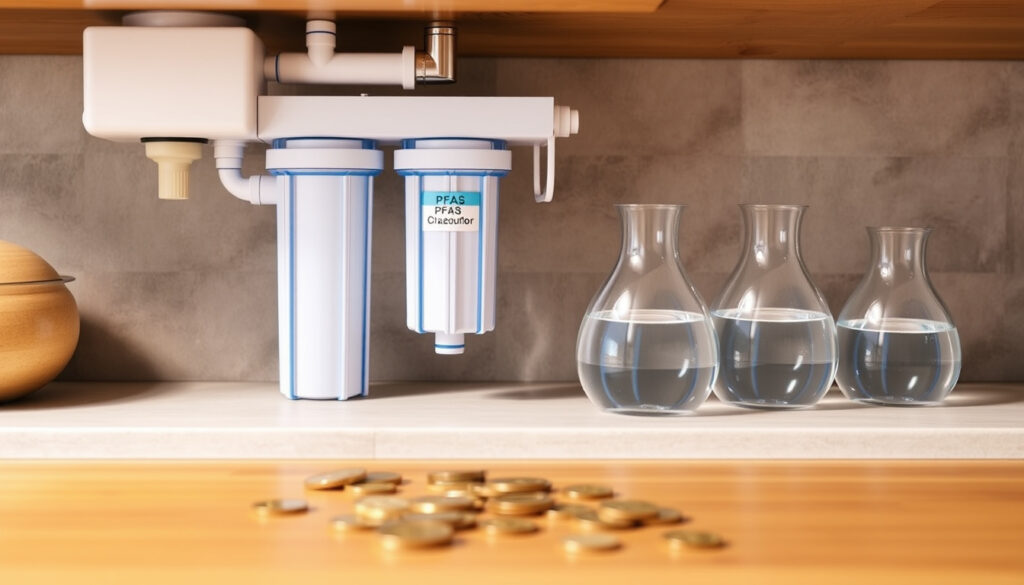
Water Filter System Guide: Best for PFAS, Chlorine & Cost
You trust the water coming out of your tap, but what’s really in it—old pipes, agricultural runoff, and industrial chemicals like PFAS? This guide cuts through the marketing to show you what actually works—based on lab certifications, real-world costs, and independent testing data.
Price range for drinking water filters: $20 – $1,000 (US EPA) ·
Under-sink RO system (Waterdrop G3P800): $849 (Quality Water Lab) ·
Annual maintenance cost: ~$170 (Quality Water Lab)
Quick snapshot
- Point-of-use filters can greatly reduce PFAS levels (US EPA)
- NSF/ANSI 53 and 58 certifications are reliable indicators of PFAS removal (Consumer Reports)
- Reverse osmosis systems remove most contaminants, including heavy metals and microbes (US EPA)
- Effectiveness of common pitcher filters against newer PFAS variants is not well documented (Consumer Reports)
- Long-term health impact of trace microplastics remains under study (US EPA)
- Independent verification of removal rates for many filter brands is still limited (Quality Water Lab)
- EPA proposed a maximum contaminant level of 4 ppt for PFOA and PFOS (US EPA)
- Regulatory push is driving innovation in whole-house catalytic carbon systems (Quality Water Lab)
- Expect more whole-house systems with catalytic carbon stages designed for PFAS (Quality Water Lab)
- NSF/ANSI 53 and 58 standards will likely tighten as new PFAS compounds emerge (Consumer Reports)
Six key specs drawn from lab data and certification standards give a quick baseline for comparing systems.
| Specification | Value | Source |
|---|---|---|
| EPA price range for drinking water filters | $20 – $1,000 | US EPA |
| Waterdrop G3P800 unit price | $849 | Quality Water Lab |
| Flow rate (Waterdrop G3P800) | 800 GPD | Quality Water Lab |
| Waste ratio (Waterdrop G3P800) | 3:1 (pure:waste) | Quality Water Lab |
| Annual filter cost (Waterdrop G3P800) | ~$170 | Quality Water Lab |
| PFAS analytes removed in lab test | 14 of 14 | Quality Water Lab |
Price isn’t the only variable. A $50 pitcher may do little for PFAS, while a $849 RO system like the Waterdrop G3P800 removes nearly every tested compound. The trade-off is upfront cost vs. long-term peace of mind.
What is the best water filtration system for home use?
Under-sink vs countertop vs whole-house systems
Under-sink systems, point-of-use devices installed below the counter, offer a middle ground: they treat one faucet with high efficiency. The US EPA notes that point-of-use filters (including under-sink and countertop) can greatly reduce PFAS levels. Whole-house systems treat all water entering the home but come with a higher price tag and professional installation. Countertop filters require no plumbing but have limited flow.
Top-rated filters for 2026 by lab tests
- Under-sink RO: Waterdrop G3P800 – certified to NSF/ANSI 42, 53, 58, and 372 (Quality Water Lab)
- Whole-house catalytic carbon: Best pick from Quality Water Lab for PFAS removal (Quality Water Lab)
- Pitcher: Choose models with NSF/ANSI 53 certification; most basic pitchers do not remove PFAS (Consumer Reports)
How to choose based on water quality report
Start with your local water utility’s annual Consumer Confidence Report. If it shows PFAS above the EPA’s proposed 4 ppt advisory level, a certified RO system is the most reliable option. For general taste and odor improvement (chlorine, sediment), a carbon pitcher or faucet filter may suffice – but verify certification.
The implication: matching filter technology to your actual contaminant profile avoids overpaying for features you don’t need.
What water filter removes PFAS?
Activated carbon vs reverse osmosis
Both technologies can remove PFAS, but reverse osmosis consistently outperforms. According to the US EPA, granular activated carbon (GAC) and ion exchange systems can reduce PFAS, but reverse osmosis systems certified to NSF/ANSI 58 achieve higher removal rates. The Waterdrop G3P800 removed 14 of 14 PFAS analytes in independent testing (Quality Water Lab).
Certified filters (NSF/ANSI 53, 58)
Consumer Reports emphasizes looking for certification from NSF, WQA, IAPMO, UL Solutions, CSA Group, or Intertek. NSF/ANSI 53 covers filters that reduce PFAS through carbon or other media; NSF/ANSI 58 applies to reverse osmosis systems.
Brita and pitcher filter limitations
Most pitcher filters, including popular Brita models, are not certified to remove PFAS. The EPA warns that filters only work if maintained properly. For PFAS, a pitcher is unlikely to provide adequate protection unless it explicitly carries NSF/ANSI 53 certification for PFAS reduction.
Even certified filters need regular cartridge changes. Skipping replacement schedules can let contaminants slip through – the EPA stresses that maintenance is as important as the initial purchase.
The pattern: certification is the only reliable shortcut, but it requires ongoing commitment.
Do water filters remove chlorine?
How activated carbon works
Activated carbon filters adsorb chlorine molecules as water passes through, improving taste and odor. The EPA groups chlorine among the chemical contaminants that point-of-use carbon filters can reduce, though specific removal percentages depend on filter design, flow rate, and contact time.
Pour-through vs faucet vs whole-house
Pour-through pitchers and faucet-mounted units both rely on carbon cartridges. Faucet filters generally have faster flow and longer cartridge life. Whole-house carbon tanks treat all water, reducing chlorine in showers as well as drinking water. No single type universally performs best – test your water’s chlorine level first.
Cheapest DIY methods to dechlorinate
Letting a pitcher of tap water sit in the refrigerator for an hour can naturally reduce chlorine through evaporation, but this is slow and inconsistent. A basic carbon pitcher filter (e.g., Brita) offers reliable chlorine reduction for about $0.10 per gallon – the most cost-effective option for households without PFAS concerns.
How much does it cost to install a water filtration system?
Price range by system type
- Pitcher filter: $20 – $50 (no installation)
- Faucet-mounted: $30 – $100 (DIY install)
- Countertop: $50 – $200 (no plumbing)
- Under-sink RO: $200 – $1,000 (DIY or pro install)
- Whole-house system: $1,000 – $3,000 (professional install)
These figures align with the EPA’s noted consumer price range of $20 to $1,000 for drinking water filters, excluding whole-house systems.
Installation labor costs
Professional installation for an under-sink RO system typically adds $100 – $300, while whole-house systems can cost $500 – $1,500 for labor. DIY installation is possible for many countertop and under-sink models, but be prepared for basic plumbing work.
Long-term maintenance and filter replacement costs
Annual filter replacement runs $50 – $200 for most systems. The Waterdrop G3P800, for example, costs about $170 per year in replacement cartridges (Quality Water Lab). Factor in sediment pre-filters and post-carbon filters – each adds $20 – $50 annually.
The catch: initial savings on point-of-use systems can erode if you ignore filter replacement schedules.
What are the disadvantages of a whole house water filter?
Initial cost and maintenance
Whole-house systems start at $1,000 and can exceed $3,000 installed. Annual maintenance (sediment replacement, carbon change-out, UV bulb if included) adds $200 – $600. The EPA notes that all filters require proper maintenance to work effectively – whole-house systems have more components that can fail.
Water pressure reduction
Adding filtration stages directly reduces water pressure. A typical whole-house carbon block filter can drop pressure by 5–15 psi. For households already on low-pressure municipal or well water, this can cause noticeable slowing at showers and appliances. Pressure-boosting pumps add cost and complexity.
Waste water from reverse osmosis whole-house
Whole-house RO systems generate significant waste water – the Waterdrop G3P800 has a 3:1 pure-to-waste ratio, meaning for every gallon of filtered water, about 0.33 gallons go down the drain. At whole-house scale, this can waste hundreds of gallons per month. Most homeowners opt for point-of-use RO instead.
Whole-house filters promise convenience, but the combined cost of installation, maintenance, and potential pressure loss makes them a poor fit for many homes. Unless you need to treat every tap for sediment or chlorine, a point-of-use system is often smarter.
What this means: whole-house solutions should be reserved for broad contamination issues, not general taste improvement.
What is the healthiest filter for tap water?
Reverse osmosis vs carbon vs distillation
Reverse osmosis removes the broadest spectrum of contaminants: PFAS, heavy metals, nitrates, fluoride, and microbes. Carbon filters retain beneficial minerals like calcium and magnesium but miss some inorganics. Distillation yields very pure water but strips minerals entirely – the World Health Organization notes that demineralized water may not be optimal for long-term health. For most households, a certified RO system with remineralization offers the best balance.
Mineral retention and pH balance
Carbon filters leave minerals intact, preserving water’s natural pH and taste. RO systems typically lower pH (making water slightly acidic) and remove minerals – some include a remineralization cartridge to add back calcium and magnesium. Distillation results in flat-tasting water with no minerals.
EPA and WHO guidelines on water purity
The EPA recommends filters that meet NSF/ANSI standards for specific contaminants. The WHO advises that drinking water should contain at least minimal levels of essential minerals. The “healthiest” filter depends on your source water: if heavy metals or PFAS are present, RO is essential; if taste is the only issue, carbon is sufficient.
Four systems, one pattern: each trades off between contaminant removal and mineral retention. The table below sums it up.
| System | PFAS removal | Mineral retention | Annual cost | Best for |
|---|---|---|---|---|
| Under-sink RO | >95% (certified) | Low (add remineralization) | $100-$200 | PFAS, heavy metals, general purity |
| Whole-house carbon | Moderate (depends on media) | High | $200-$600 | Chlorine, sediment, taste |
| Countertop carbon | Low (unless certified) | High | $50-$150 | Chlorine, basic taste improvement |
| Pitcher carbon | Minimal | High | $30-$80 | Cost-effective taste/odor |
The evidence is clear: no single filter fits every household. The decision hinges on your local water quality report and your budget.
Upsides
- Certified under-sink RO systems provide near-complete protection against PFAS
- Carbon filters are inexpensive and improve taste without removing minerals
- Point-of-use options are affordable and require no professional installation
- EPA and Consumer Reports provide clear certification guidance
Downsides
- Whole-house systems are expensive and reduce water pressure
- RO systems waste water and remove beneficial minerals unless equipped with remineralization
- Pitcher filters rarely remove PFAS despite marketing claims
- Maintenance schedules are easy to neglect, rendering filters ineffective
The pattern: your local water report dictates which trade-offs are acceptable, not generic marketing hype.
crystalquest.com, techgearlab.com, youtube.com, ispringfilter.com
Frequently asked questions
Do water filters remove bacteria and viruses?
Most carbon and sediment filters do not remove bacteria or viruses. Reverse osmosis systems with a UV stage can, but check NSF/ANSI 55 for ultraviolet certification. Boiling is still the most reliable method for microbial safety.
How often should I replace my water filter?
Replacements vary: pitcher filters every 2 months, under-sink carbon cartridges every 6 months, RO membranes every 2-3 years, and whole-house sediment filters every 3-6 months. Always follow the manufacturer’s schedule – the EPA warns that skipped replacements can let contaminants through.
What is the difference between a water filter and a water softener?
A water filter removes contaminants (chemicals, sediment, microbes) for drinking water. A water softener exchanges calcium and magnesium ions for sodium or potassium to prevent scale buildup. Softeners do not remove PFAS or chlorine. Many homes benefit from both.
Can water filters remove lead?
Yes, filters certified to NSF/ANSI 53 for lead reduction can remove lead. Most activated carbon and RO systems with certification effectively reduce lead levels. Always check the certification – not all filters are tested for lead.
Is bottled water filtered better than tap water?
Bottled water is not necessarily safer. The EPA regulates tap water; the FDA regulates bottled water. Many bottled brands are simply filtered tap water. A certified home RO system often outperforms bottled water at a fraction of the cost per gallon.
What size water filter do I need for my family?
For a family of four, an under-sink RO system with a 3-4 gallon storage tank (50-100 GPD flow) is sufficient for drinking and cooking. Whole-house systems are sized by flow rate (e.g., 10-15 GPM for a typical home). Check your peak demand to avoid pressure drops.
Do water filters remove fluoride?
Standard carbon filters do not remove fluoride. Reverse osmosis systems and specific activated alumina filters can reduce fluoride. If fluoride removal is a priority, look for NSF/ANSI 58 certification for RO or a dedicated fluoride filter.
For readers concerned about kidney health and water quality, see our guide on Chronic Kidney Disease: Symptoms, Causes, Stages, Life Expectancy. And if you’re organizing your kitchen alongside your filtration, check Meal Prep Containers: Best Options Tested for Safety.
More related posts
 Chicken and Rice Recipes: Flavorful One-Pot & Global Twists
 2023 Isuzu MU-X: Price, Specs, Reliability & Common Problems
 Anthony Mackie: Biography, Wife, Kids, and Net Worth
 Carrie Coon Biography: Age, Husband, Movies & TV Shows
 Peter O’Toole: Irish Identity, Drinking, and Lasting Legend
 Qatar Airways Guide: Reviews, Policies, Comparison with Emirates
 Samsung Education Store: Discounts, Access & Locations
 Rinky Hijikata: Bio, Age, Height, Ranking & Ethnicity Facts