The Picture of Dorian Gray: Summary, Controversy & Analysis
There’s something about a portrait that refuses to stay still—something that makes you wonder what it would look like if it could show everything you’ve tried to hide. That’s the premise Oscar Wilde built his most famous novel around, and when The Picture of Dorian Gray first appeared in 1890, it sparked immediate outrage and later became a central work in queer literary studies.
Published: 1890 (Lippincott’s Monthly Magazine) ·
Author: Oscar Wilde ·
Genre: Gothic horror, philosophical fiction ·
Page count: Approximately 240 (standard edition) ·
Original title: The Picture of Dorian Gray ·
Key themes: Aestheticism, moral corruption, vanity, duplicity
Quick snapshot
- First published in Lippincott’s Monthly Magazine in July 1890 (Encyclopaedia Britannica (general reference)).
- Oscar Wilde revised and expanded the novel for book publication in 1891 (British Library (national archive)).
- Dorian Gray murders Basil Hallward (British Library (national archive)).
- The novel ends with Dorian stabbing the portrait and dying (Encyclopaedia Britannica (general reference)).
- The exact words Oscar Wilde spoke on his deathbed are disputed (Encyclopaedia Britannica (biographical resource)).
- Whether Wilde intended the novel as a queer allegory is debated among scholars (The Gay & Lesbian Review (LGBTQ literary journal)).
- Interpretations of Basil Hallward’s feelings toward Dorian remain open to analysis (Literary Hub (literary analysis site)).
- The portrait’s meaning as a symbol of repressed desire is a critical interpretation, not a confirmed fact (University of Mary Washington student research (academic analysis)).
- The degree of Lord Henry’s responsibility for Dorian’s corruption is debated (Encyclopaedia Britannica (general reference)).
- 1890 – Magazine publication triggers moral panic (British Library (national archive)).
- 1891 – Revised book edition with a new preface (British Library (national archive)).
- 1895 – Wilde’s trial uses the novel as evidence (Encyclopaedia Britannica (biographical resource)).
- 1900 – Wilde dies in Paris (Encyclopaedia Britannica (biographical resource)).
- Continued academic interest in queer readings of the novel (The Gay & Lesbian Review (LGBTQ literary journal)).
- New film and streaming adaptations reach broader audiences (Encyclopaedia Britannica (general reference)).
- Ongoing debates about censorship and Victorian morality (British Library (national archive)).
Eight key facts about the novel, pulled from authoritative sources, show the scope of Wilde’s work.
| Attribute | Detail |
|---|---|
| Full title | The Picture of Dorian Gray |
| Author | Oscar Wilde |
| First published | 1890 (magazine), 1891 (book) |
| Genre | Gothic horror, philosophical fiction |
| Protagonist | Dorian Gray |
| Antagonist | Lord Henry Wotton (influence) |
| Key symbol | The portrait |
| Notable adaptation | 1945 film directed by Albert Lewin |
What is The Picture of Dorian Gray about?
Plot overview
The novel follows Dorian Gray, a young man whose portrait ages and bears the marks of his corrupt life while he remains youthful (Encyclopaedia Britannica (general reference)). The story opens in the studio of painter Basil Hallward, who becomes infatuated with Dorian’s beauty. Under the influence of Lord Henry Wotton, a cynical hedonist, Dorian wishes that the portrait would age instead of him. The wish comes true, and Dorian begins a life of indulgence and cruelty while his face stays unchanged. His portrait grows grotesque, reflecting every sin. In the end, Dorian destroys the portrait and dies.
Key characters: Dorian Gray, Basil Hallward, Lord Henry Wotton
- Dorian Gray – The protagonist, a handsome young man who becomes morally bankrupt.
- Basil Hallward – The artist who paints the portrait and is devoted to Dorian (Literary Hub (literary analysis site)).
- Lord Henry Wotton – A charismatic aristocrat whose hedonistic philosophy corrupts Dorian (Encyclopaedia Britannica (general reference)).
The central conceit: the portrait absorbs the sins
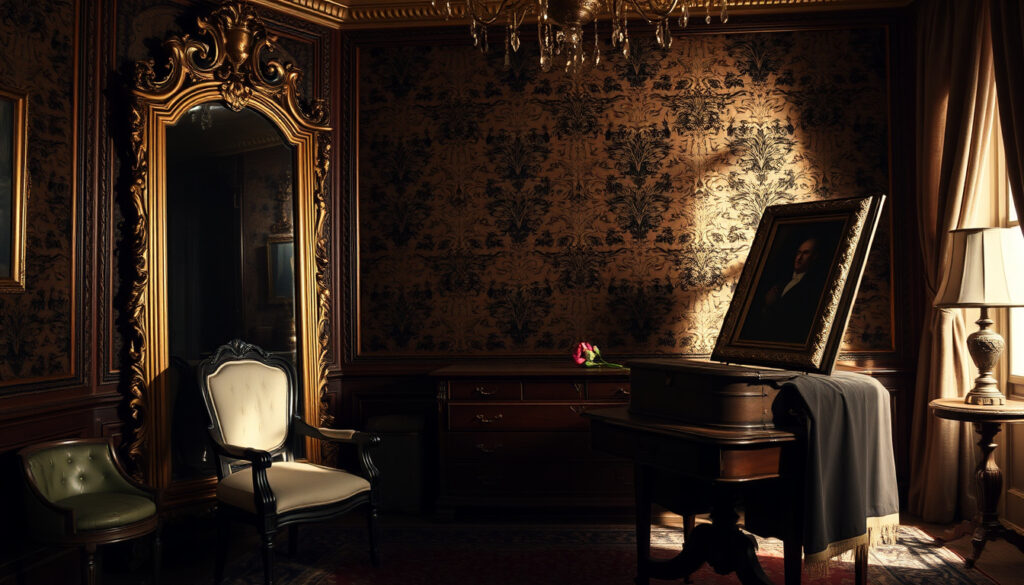
The portrait is the engine of the plot. While Dorian’s own face remains youthful and unlined, the canvas records every mark of his vices—lies, betrayals, even murder. Many modern critics read the portrait as a symbol of repressed desire, guilt, and double identity rather than a simple supernatural device (University of Mary Washington student research (academic analysis)).
“The painter gazed at the gracious and comely form he had so skilfully mirrored, and his own face became suffused with a smile of pleasure.” – Basil Hallward, describing his work
Basil Hallward (character)
The implication: the conceit works as a perfect metaphor for the pressure to maintain a respectable public image while concealing private identity—a theme that resonates powerfully with queer readers.
Why is The Picture of Dorian Gray so controversial?
Victorian moral panic
When the novel first appeared in 1890, critics condemned it as immoral and corrupting. The Daily Chronicle attacked the book as “unhealthy” and “decadent,” helping define the early controversy around its reception (British Library (national archive)). The accusation of “decadence” was a common label applied to fin‑de‑siècle literature associated with aestheticism and open sexuality (Encyclopaedia Britannica (general reference)).
Accusations of indecency
The homoerotic subtext between Basil and Dorian was considered scandalous. Basil’s intense attachment to Dorian is widely treated by critics as one of the novel’s key queer‑coded relationships (Literary Hub (literary analysis site)). The 1890 magazine version contained passages that later editors and publishers cut or softened, especially around sexuality and moral ambiguity (Literary Hub (literary analysis site)).
Wilde’s trial and the novel as evidence
In 1895, Wilde was arrested and later convicted of gross indecency; his own novel was used as evidence of his depravity (Encyclopaedia Britannica (biographical resource)). Male same‑sex acts were criminalized in Victorian Britain, shaping what could be said openly in Wilde’s fiction (British Library (national archive)). The Cleveland Street scandal of 1889, a contemporary homosexual scandal, was frequently cited by critics discussing coded references in Wilde’s era (Encyclopaedia Britannica (historical event resource)).
Victorian authorities treated Dorian Gray as a moral threat precisely because it refused to condemn its protagonist’s desires—making it a lightning rod for cultural anxiety about homosexuality.
The novel’s suppression highlights the Victorian era’s intolerance of non-normative desire.
Is there LGBTQ content in The Picture of Dorian Gray?
Homoerotic undertones
The relationship between Basil Hallward and Dorian Gray carries strong romantic and aesthetic attraction. Basil himself confesses, “I have grown to love you,” and critics have long noted the erotic charge in his descriptions. Lord Henry’s speeches challenge conventional gender roles and sexuality (Encyclopaedia Britannica (general reference)).
Queer theory interpretations
Modern queer readings find explicit homoeroticism in the original manuscript that was later censored. The novel is considered a seminal work in the LGBTQ literary canon (The Gay & Lesbian Review (LGBTQ literary journal)). Some critics connect the portrait’s corruption to social shame and the concealment of non‑normative desire in Victorian culture (GradeSaver (study guide resource)).
Coded language in Victorian literature
Because open discussion of same‑sex desire was illegal, authors like Wilde used coded language—aesthetics, euphemisms, and indirect references. Readers attuned to these codes could pick up on the subtext, while general readers could dismiss it as innocent admiration. Richard Ellmann described Wilde as insisting that the 1891 book version of Dorian Gray was still artistically valid despite criticism (The New York Review of Books (literary criticism)).
“There is no such thing as a moral or an immoral book. Books are well written, or badly written. That is all.” – Oscar Wilde, preface to the 1891 edition
Oscar Wilde (preface)
Why this matters: the novel is among the earliest examples of an English‑language text that explicitly courts a double reading—a straight narrative on the surface, a queer one underneath.
Why did Dorian Gray turn evil?
Influence of Lord Henry
Dorian is initially innocent but becomes corrupted after being exposed to Lord Henry’s hedonistic philosophy. Lord Henry’s influence is often read as central to Dorian’s fixation on youth, beauty, and surface appearance (Encyclopaedia Britannica (general reference)).
The portrait as enabler
The wish that the portrait age instead of him removes visual consequences, enabling unchecked vice. Dorian’s descent includes manipulating, abandoning, and murdering people. He kills Basil Hallward after confronting him about the portrait and later forces a former lover to commit suicide.
Philosophical roots: aestheticism and hedonism
The novel explores the conflict between beauty and morality. Wilde, through Lord Henry, presents aestheticism—the pursuit of beauty and sensory experience as life’s highest goal. But Dorian takes that philosophy to its logical extreme, showing that without ethical constraints, aestheticism becomes self‑destruction. Some readers treat the novel as a moral cautionary tale about vanity, while others treat it as a coded queer text; both readings have long coexisted in criticism (GradeSaver (study guide resource)).
Dorian’s evil is not innate; it is taught. Lord Henry’s philosophy liberates Dorian from conventional morality but leaves him without any moral compass, proving that freedom without responsibility is a kind of prison.
Dorian’s downfall demonstrates the danger of aestheticism without ethics.
What did Oscar Wilde say on his deathbed?
The reported deathbed conversion
Wilde reportedly converted to Catholicism on his deathbed in 1900 (Encyclopaedia Britannica (biographical resource)).
Conflicting accounts
The exact words are disputed; no single reliable source exists. Some accounts claim he said, “I am dying beyond my means,” while others report expressions of regret. This personal moment mirrors the novel’s preoccupation with sin and redemption.
Connection to Dorian Gray’s themes of redemption
Whether Wilde actually asked for forgiveness or remained defiant to the end, the uncertainty itself echoes the novel’s ambiguity about whether Dorian could ever be redeemed. The lack of a definitive deathbed statement leaves room for interpretation—much like the novel itself.
The uncertainty of Wilde’s final words mirrors the ambiguous morality of his novel.
What adaptations of The Picture of Dorian Gray exist?
Film adaptations (1945, 2009, etc.)
The most famous film is the 1945 MGM version starring George Sanders as Lord Henry Wotton, directed by Albert Lewin, which was nominated for Academy Awards (Encyclopaedia Britannica (general reference)). A 2009 adaptation featured Ben Barnes as Dorian and Colin Firth as Lord Henry.
Television and streaming versions
Netflix offers the 2009 film version titled Dorian Gray. Several TV mini‑series and BBC radio dramas have also adapted the story.
Stage and radio productions
The novel has been adapted for stage, opera, and BBC radio. The enduring appeal of the concept—a portrait that carries the consequences of its owner’s sins—makes it a favorite for reinterpretation.
Publication and legacy timeline
- 1890 – Magazine publication in Lippincott’s Monthly Magazine, attracting moral outrage (Encyclopaedia Britannica (general reference)).
- 1891 – Revised book edition released with added chapters and toned‑down homoerotic content (British Library (national archive)).
- 1895 – Wilde’s trial for gross indecency; the novel used as evidence against him (Encyclopaedia Britannica (biographical resource)).
- 1900 – Oscar Wilde’s death in Paris; deathbed conversion to Catholicism (Encyclopaedia Britannica (biographical resource)).
- 1945 – First major film adaptation, directed by Albert Lewin, nominated for Academy Awards (Encyclopaedia Britannica (general reference)).
- 2009 – Film adaptation starring Ben Barnes and Colin Firth (Encyclopaedia Britannica (general reference)).
- Present – The novel remains widely read, critically studied, and frequently adapted across media.
The timeline shows the novel’s enduring relevance across decades.
Confirmed facts
- The novel was published in 1890 and 1891 (Encyclopaedia Britannica (general reference)).
- Oscar Wilde was imprisoned for homosexuality in 1895 (Encyclopaedia Britannica (biographical resource)).
- The portrait is the central plot device (British Library (national archive)).
- Dorian Gray murders Basil Hallward (British Library (national archive)).
- The novel ends with Dorian stabbing the portrait and dying (Encyclopaedia Britannica (general reference)).
What’s unclear
- The exact words Oscar Wilde spoke on his deathbed are disputed (Encyclopaedia Britannica (biographical resource)).
- Whether Wilde intended the novel as a queer allegory is debated among scholars (The Gay & Lesbian Review (LGBTQ literary journal)).
- Interpretations of Basil Hallward’s feelings toward Dorian remain open to analysis (Literary Hub (literary analysis site)).
- The portrait’s meaning as a symbol of repressed desire is a critical interpretation, not a confirmed fact (University of Mary Washington student research (academic analysis)).
- The degree of Lord Henry’s responsibility for Dorian’s corruption is debated (Encyclopaedia Britannica (general reference)).
“I have grown to love you. I am not speaking of mere physical beauty. I am speaking of the beauty of your soul.” – Basil Hallward, revealing his devotion
Basil Hallward (character)
“The only way to get rid of a temptation is to yield to it.” – Lord Henry Wotton, advising Dorian
Lord Henry Wotton (character)
“I am dying beyond my means.” – Attributed to Oscar Wilde, deathbed remark (disputed)
Oscar Wilde (attributed)
The novel’s lasting power comes from its refusal to moralise neatly. For modern readers, the challenge to Victorian hypocrisy—and to any society that demands a flawless public face—remains urgent. The portrait never stops asking: what are you hiding?
For those interested in the novel’s enduring legacy, a detailed summary and analysis is available to provide further context.
Frequently asked questions
Is The Picture of Dorian Gray a horror novel?
Yes, it is classified as Gothic horror and philosophical fiction (Encyclopaedia Britannica (general reference)).
Who is Basil Hallward in The Picture of Dorian Gray?
Basil is the painter who creates the portrait and becomes emotionally attached to Dorian (Literary Hub (literary analysis site)).
What does the portrait symbolize in The Picture of Dorian Gray?
It symbolizes hidden guilt, repressed desire, and the duality of human nature (University of Mary Washington student research (academic analysis)).
How many pages is The Picture of Dorian Gray?
Standard editions run approximately 240 pages (Encyclopaedia Britannica (general reference)).
Is there a good movie adaptation of The Picture of Dorian Gray?
The 1945 film directed by Albert Lewin is the most critically acclaimed (Encyclopaedia Britannica (general reference)).
What is the main message of The Picture of Dorian Gray?
The novel warns that the pursuit of pleasure without moral constraint leads to destruction (GradeSaver (study guide resource)).
Where can I read The Picture of Dorian Gray for free?
The full text is available at Project Gutenberg (Project Gutenberg (free ebook repository)).
These questions reflect common reader curiosities about the novel’s plot and themes.
More related posts
 Liam Payne Cause of Death: What We Know
 Cliff Burton Death: Bus Crash, Last Words, Royalties
 Murrumba Downs Medical Centre: Hours, Phone, Address, Booking
 Kaley Cuoco: Diagnosis, Children, Penny Questions & Net Worth
 Wanda Sykes: Net Worth, Children, LGBTQ Identity & Career
 Lara Katseye: Real Name, Age, Ethnicity, and LGBTQ Identity
 Rinky Hijikata: Bio, Age, Height, Ranking & Ethnicity Facts
 Keli Lane Case: Latest News and Unanswered Questions