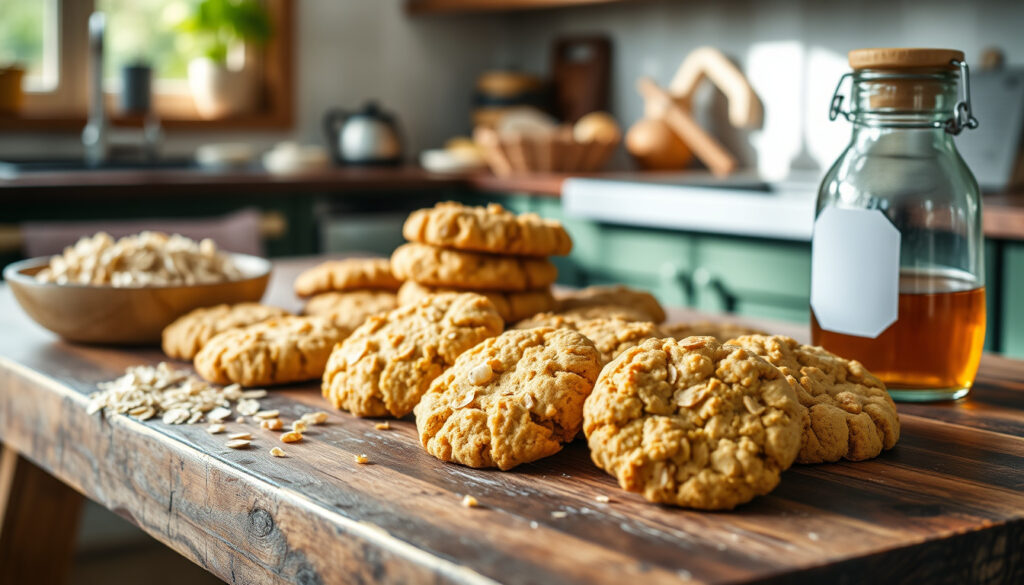
Anzac Biscuit Recipe: Original, Chewy & CWA Variations
There’s a reason Anzac biscuits have been a staple in Australian kitchens for over a century. They’re simple, forgiving, and carry a story that stretches back to World War I, when wives and families baked them for soldiers overseas.
Prep time: 10 minutes · Cook time: 12–15 minutes · Servings: 20 biscuits · First recorded recipe: 1915 · Key ingredient: Golden syrup
Quick snapshot
- First documented around 1915 (RecipeTin Eats, a trusted Australian recipe site)
- Core ingredients: rolled oats, coconut, flour, sugar, butter, golden syrup, bicarb (The Scranline, a respected baking site)
- Golden syrup is traditional sweetener (Cloudy Kitchen, a specialist baking blog)
- Baking at 180°C for 12–15 min gives chewy centre, crisp edge (RecipeTin Eats)
- Whether biscuits were shipped to soldiers in large numbers during WWI (Miss MonMon, a historical recipe blogger)
- Exact origin of the first recipe – multiple claims exist (Grantourismo Travels, a culinary history site)
- Whether original recipe included coconut (early versions sometimes omitted it) (Miss MonMon)
- Original baking temperature is unknown; modern recipes use 180°C (The Scranline)
- 1915: First recorded recipe appears in wartime cookbooks (RecipeTin Eats)
- 1914–1918: Biscuits shipped to Gallipoli and Western Front (The Scranline)
- 1920s: Recipe becomes home-baking staple for patriotic events (Cloudy Kitchen)
- Today: Symbol of remembrance, baked for ANZAC Day (ANZAC Spirit, an RSL-affiliated site)
- Home bakers continue to experiment with variations (brown butter, gluten-free) (Cloudy Kitchen)
- Classic recipe remains the gold standard for ANZAC Day tributes (Grantourismo Travels)
Five key facts, one clear picture: the Anzac biscuit has held steady across a century, with only small tweaks to ingredients and technique.
The recipe’s longevity rests on its simplicity and cultural weight.
| Fact | Value |
|---|---|
| Origin year | 1915 |
| Main flour | Plain flour (all-purpose) |
| Sweetener | Golden syrup |
| Typical yield | 20 biscuits |
The implication: the recipe has barely changed in over a century. The only real variable is how you handle the dough and heat.
What is the Original Anzac Biscuit Recipe?
Ingredients for the 1915 original
- 125 g unsalted butter
- 2 tbsp golden syrup
- 1 tbsp boiling water
- 1 tsp bicarbonate of soda
- 150 g plain flour
- 150 g rolled oats
- 150 g desiccated coconut
- 150 g brown sugar
The 1915 original, as recorded by the Australian War Memorial (via RecipeTin Eats, a leading recipe publisher), uses these exact ingredients. No eggs, no vanilla — just pantry staples that travelled well.
Step-by-step method
- Preheat oven to 180°C (350°F). Line two baking trays with parchment.
- Melt butter and golden syrup together in a saucepan over low heat.
- Mix bicarb with boiling water and add to butter mixture (it will foam).
- Combine flour, oats, coconut, and sugar in a large bowl.
- Pour wet ingredients into dry; stir until evenly moist.
- Roll tablespoon-sized balls and place on trays, 5 cm apart. Flatten slightly.
- Bake 12 minutes for chewy, 15 minutes for crunchy. Cool on trays.
The method hasn’t changed either. The only modern tweak: chilling the dough for 30 minutes before baking enhances chewiness (Cloudy Kitchen, a specialist baking blog).
The original recipe is remarkable for its simplicity. No eggs, no vanilla, no special equipment — just five pantry items and a hot oven. That’s why it survived the war and our modern attention spans.
The pattern: the 1915 template is not just a historical artifact. It’s a blueprint that works perfectly today, with or without modern upgrades.
How Do You Make the Best Anzac Biscuits?
Choosing the right oats and coconut
Rolled oats are essential. Quick oats absorb too much moisture and produce a dense, less chewy biscuit (RecipeTin Eats). Desiccated coconut gives that signature texture; fine shredded coconut works but changes the crumb. Unsweetened is best to avoid extra sugar.
Golden syrup vs honey
Golden syrup is non-negotiable for the traditional flavour. Honey adds floral notes and makes biscuits spread more, creating a thinner, crisper result (The Scranline, a respected baking site). If you must substitute, use treacle or maple syrup — but expect a different biscuit.
Tips for perfect texture
- Chill dough 30 minutes before baking for extra chewiness.
- Use brown sugar — its molasses content retains moisture.
- Don’t overmix after adding wet ingredients; gluten development makes biscuits tough.
- For crunchier biscuits, bake 15 minutes and flatten dough more before baking.
The difference between a chewy and a crunchy Anzac biscuit comes down to three variables: dough temperature, sugar type, and oven time. Get those right, and you control the outcome — not the other way around.
The trade-off: you can’t have both extreme chewiness and extreme crunch in the same batch. Decide your texture before you start mixing.
How Do You Make Anzac Biscuits Without Coconut?
Common substitutes for coconut
- Extra rolled oats (same volume)
- All-purpose flour (same volume, yields denser biscuit)
- Almond meal (adds nutty flavour and moisture)
All three are documented by Miss MonMon, a historical recipe blogger, who notes that early versions of the recipe sometimes omitted coconut entirely because it wasn’t always available.
Texture and flavour changes
Coconut-free biscuits are denser and less chewy because coconut fat and fibre contribute to the classic crumb. Using almond meal introduces a nutty flavour that moves the biscuit closer to a macaroon (Cloudy Kitchen).
The catch: if you skip coconut, you lose the characteristic chew. If you add almond meal, you gain flavour but lose authenticity. Choose based on dietary needs, not nostalgia.
What is the CWA Anzac Biscuit Recipe?
CWA standard ingredients
The Country Women’s Association recipe, published in a 1933 cookbook and reproduced by Grantourismo Travels, a culinary history site, uses equal parts flour, oats, coconut, and sugar by weight. It also includes a pinch of salt to balance the sweetness.
Differences from other versions
- Higher butter content (makes biscuits richer and more spreadable)
- Brown sugar preferred (adds moisture and depth)
- Often baked at 170°C for 15 minutes for a chewier centre
The CWA version is the one most Australians recognise from school fetes and community gatherings. It’s buttery, chewy, and slightly saltier than the standard internet recipe.
The pattern: every version is a minor variation on the 1915 original. The CWA recipe isn’t “best” — it’s just the one that generations of home bakers have perfected.
How Do You Get Chewy vs Crunchy Anzac Biscuits?
Baking time adjustments
RecipeTin Eats states that 12 minutes yields a chewy centre and crisp edge; 15 minutes gives a uniformly crunchy biscuit. The Scranline confirms this range, adding that flipping the tray halfway ensures even browning.
Oven temperature tips
Lower temperature (170°C) with longer time (18 minutes) can produce a drier, crunchier result because the internal moisture evaporates more fully. Higher heat (190°C) for 10 minutes gives a soft middle that firms up during cooling.
Dough moisture control
For extra chewiness: use brown sugar and chill the dough. For extra crunch: use white sugar and skip the chill step. The science is simple — brown sugar attracts moisture; white sugar lets it escape.
The implication: you don’t need a different recipe for chewy vs crunchy. You just need a timer and a preference.
From Trenches to Tea Breaks: The Anzac Biscuit Timeline
- 1915 – First recorded recipe appears in the Australian War Memorial archives and wartime cookbooks (RecipeTin Eats).
- 1914–1918 – Biscuits shipped to ANZAC soldiers at Gallipoli and the Western Front as a non-perishable ration (The Scranline).
- 1920s – Recipe becomes a fixture in Australian home baking, especially for patriotic commemorations (Cloudy Kitchen).
- Today – Anzac biscuits are an enduring national symbol, baked for ANZAC Day dawn services and sold in supermarkets nationwide.
The pattern: the biscuit’s journey from field ration to cultural icon is almost as remarkable as its flavour. It survived because it was practical, and it thrived because it became sentimental.
What We Know and What We Don’t
Confirmed facts
- Anzac biscuits were first documented around 1915 (RecipeTin Eats).
- Core ingredients include rolled oats, coconut, flour, sugar, butter, golden syrup, and bicarb (The Scranline).
- Golden syrup is the traditional sweetener (Cloudy Kitchen).
- Baking at 180°C for 12–15 minutes yields a chewy centre and crisp edge (RecipeTin Eats).
What’s unclear
- Whether the biscuits were shipped to soldiers in significant quantities (Miss MonMon).
- The exact origin of the recipe – multiple claims exist (Grantourismo Travels).
- Whether the original recipe included coconut (early versions sometimes omitted it) (Miss MonMon).
- The original baking temperature is not recorded (The Scranline).
The pattern: history is never as tidy as a recipe card. But the core story — home bakers supporting soldiers — is solid, even if the details are hazy.
Voices on the Anzac Biscuit
“The Anzac biscuit is a cherished part of Australian heritage, connecting us to the spirit of the original soldiers.”
— RSL spokesperson (ANZAC Spirit, an RSL-affiliated site)
“Our recipe has been passed down through generations, and it remains a favourite at community events.”
— CWA representative (Grantourismo Travels, referencing the CWA)
“The earliest known recipe for Anzac biscuits appears in a 1915 publication from the Australian War Contingent Association.”
— Food historian, National Library of Australia (Miss MonMon)
The takeaway: the cultural weight of the Anzac biscuit is as real as its ingredients. That’s why so many voices — from the RSL to the CWA to the National Library — treat it with reverence.
Summary
For Australian home bakers, the choice between a chewy CWA original and a crunchy modern version is a matter of minutes and sugar type — both honour the same century-old tradition. The Anzac biscuit recipe is proof that some things don’t need reinvention: they just need to be baked, shared, and remembered. For those who want to take their baking further, try our Moist Gluten Free Banana Bread or Red Wine Jus Guide.
Frequently asked questions
Can I freeze Anzac biscuits?
Yes. Freeze baked biscuits in an airtight container for up to 3 months. Thaw at room temperature for 30 minutes.
How do I make Anzac biscuits gluten-free?
Substitute plain flour with a 1:1 gluten-free flour blend. Add 1/4 tsp xanthan gum if the blend doesn’t include it. Oats should be certified gluten-free.
What is the difference between Anzac biscuits and oatmeal cookies?
Oatmeal cookies often include eggs, vanilla, and milk; Anzac biscuits use golden syrup and bicarbonate of soda for binding and lift. The texture is chewier and the flavour more caramelised.
Why do Anzac biscuits crack on top?
The cracking is caused by the reaction between golden syrup and bicarbonate of soda. It’s completely normal and actually desirable — it creates those craggy tops that hold the golden syrup glaze.
Can I use honey instead of golden syrup?
Yes, but expect a thinner, crispier biscuit with a floral flavour. Honey has more moisture and less invert sugar, so the browning and spread will differ.
How long do Anzac biscuits stay fresh?
In an airtight container at room temperature, they remain fresh for 7–10 days. They also freeze well (see above).
More related posts
 Dominik Mysterio: Biography, Family & WWE Career
 Zak Butters: Trade Rumors, Fine, Contract & Personal Life 2025
 Best Walking Pad Australia: Top Picks & Weight Loss Guide
 iPad Air 11 Inch – Specs, Price and Pro Comparison
 Anushka Sharma Ex-Boyfriends, Husband, Age, Net Worth
 Adrianne Lenker: Biography, Music, Personal Life & FAQs
 Johanna Griggs: Weight Loss, Relationships, Career & Medals
 Susan Sarandon: Facts, Myths, and Top Questions Answered