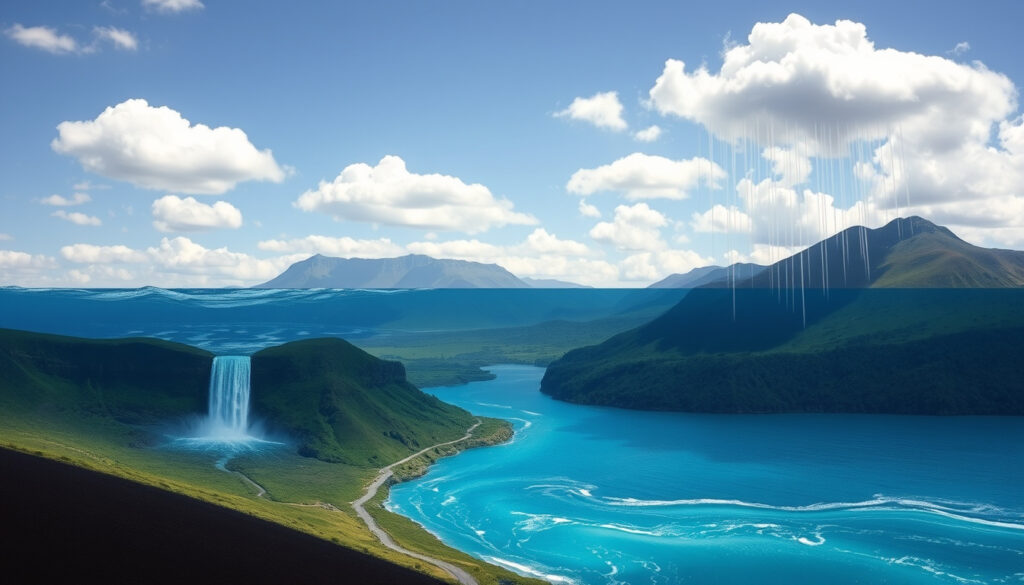
The Water Cycle Explained: 4 Stages, 7 Steps, Kids Guide
You’ve seen rain fall, felt the sun’s heat, and watched a puddle disappear—but have you ever wondered where all that water goes? The water cycle is the continuous movement of water on, above, and below Earth’s surface, driven by solar energy, according to the USGS Water Science School (the U.S. Geological Survey’s water education hub). The four main stages—evaporation, condensation, precipitation, and collection—form the backbone of the process, says National Geographic Kids (the children’s science magazine). But there’s more to the story: groundwater, transpiration, and the impact of human activity also play critical roles. By the end, you’ll see the water cycle not just as a series of steps but as a dynamic Earth system that connects every drop.
Earth’s water coverage: 71% ·
Water in the atmosphere: 0.001% of total water ·
Average residence time of water in atmosphere: 9 days ·
Number of main stages: 4 ·
Driving force: Solar energy ·
Freshwater share: 2.5%
Quick snapshot
- Liquid water turns to vapor, driven by sun and wind (USGS Water Science School)
- Main source: oceans, which cover 71% of Earth’s surface (USGS Water Science School)
- Water vapor cools and forms clouds (NASA Science, the U.S. space agency)
- Requires condensation nuclei (tiny particles in the air) (NASA Science)
- Rain, snow, sleet, hail return water to Earth’s surface (USGS Water Science School)
- Varies by region and climate; global average 119,000 km³ annually (USGS Water Science School)
- Water gathers in oceans, lakes, rivers and infiltrates into groundwater (NASA Science)
- Eventually returns to start of the cycle (NASA Science)
Six key facts capture the water cycle’s most important numbers and principles.
| Label | Value | Source |
|---|---|---|
| Water exists in | Three states: solid, liquid, gas | Britannica Kids |
| Water cycle is | Continuous, no true starting point | USGS Water Science School |
| Driving force | Solar energy | USGS Water Science School |
| Number of main stages | 4 (basic model) | National Geographic Kids |
| Transpiration | Water release from plants | NASA Science |
| Groundwater | Stored underground in soil and rock | NASA Science |
What are the water cycle 4 stages?
The water cycle’s four stages are evaporation, condensation, precipitation, and collection. This simple model is widely used in classrooms and by educational publishers like National Geographic Kids.
Evaporation
- Liquid water from oceans, lakes, and rivers turns into water vapor (USGS Water Science School)
- Driven by solar energy, which heats the water
The sun’s heat provides the energy needed to change liquid water into an invisible gas. This is the engine of the entire water cycle.
Condensation
- Water vapor rises and cools, forming tiny liquid droplets (NASA Science)
- These droplets gather around dust and salt particles, creating clouds
Without condensation nuclei, water vapor would not easily turn back into liquid. Clouds are essentially visible collections of countless microdroplets.
Precipitation
- Cloud droplets combine and grow until they fall as rain, snow, sleet, or hail (USGS Water Science School)
- Precipitation returns water to Earth’s surface, replenishing lakes and oceans
Collection
- Fallen water collects in rivers, lakes, and oceans, or soaks into the ground (NASA Science)
- Water also infiltrates into underground aquifers, becoming groundwater
The four-stage model is simple enough for a child to grasp, yet it deliberately omits processes like transpiration and runoff. The implication: a four-stage explanation is a stepping stone, not the full picture—especially when you consider that groundwater moves at a snail’s pace compared to surface water.
The implication: the four-stage model is a starting point, but the full water cycle includes more processes.
What are the 7 steps in the water cycle?
Many detailed explanations expand the cycle to seven steps: evaporation, transpiration, sublimation, condensation, precipitation, runoff, and infiltration. While the four-stage model covers the essentials, these added steps reveal the cycle’s true complexity.
Evaporation
- Same process as in the four-stage model: water turns to vapor (USGS Water Science School)
Transpiration
- Plants release water vapor from their leaves (NASA Science)
- This adds significant moisture to the atmosphere, especially over forests
Sublimation
- Ice and snow change directly into water vapor without melting (Britannica Kids notes that snow and ice are part of the cycle)
- Common in cold, dry areas like mountain peaks and polar regions
Condensation
- Water vapor cools and forms clouds (NASA Science)
Precipitation
- Water falls from clouds as rain, snow, or other forms (USGS Water Science School)
Runoff
- Water flows over land into streams, rivers, and oceans (USGS Water Science School)
Infiltration
- Water soaks into the ground and becomes groundwater (APEC Water Systems, a water treatment education site)
The catch: the seven-step model is more accurate but harder to memorize. For most everyday situations, the four-stage version is enough—but if you’re studying droughts, flooding, or climate change, the extra steps matter.
The pattern: the seven-step model offers depth for advanced learners.
How do you explain the water cycle step by step?
A step-by-step explanation helps learners see the cycle in motion. Here’s a logical walkthrough using the four-stage framework, then adding details that cover all major processes.
- Step 1: Evaporation and Transpiration
- The sun heats water in oceans, lakes, and rivers, turning it into water vapor (USGS Water Science School)
- Plants also release water vapor through transpiration (NASA Science)
- Step 2: Condensation into Clouds
- Warm, moist air rises and cools; water vapor condenses on tiny particles to form clouds (NASA Science)
- Step 3: Precipitation
- Cloud droplets grow and fall as rain, snow, sleet, or hail (USGS Water Science School)
- Step 4: Collection and Runoff
- Precipitation flows into rivers, lakes, and oceans (runoff) or soaks into the ground (infiltration) (USGS Water Science School)
- Step 5: The Cycle Continues
- Evaporation from these water bodies starts the cycle over again (NASA Science)
The trade-off: a five-step sequence works well for a middle-school audience. For younger children, the four-stage model is easier; for older students, adding transpiration and groundwater deepens understanding.
A step-by-step approach helps students connect each action to the next. The biggest teaching challenge is making clear that water doesn’t “start” anywhere—it’s always cycling.
The implication: step-by-step instruction turns abstract processes into a tangible story.
What is the water cycle for kids?
Explaining the water cycle to young children requires simple language and relatable examples. The goal is to show that water moves through the environment in a never-ending loop.
The Sun’s Role
- The sun warms water in rivers and oceans, causing it to rise as vapor (NASA Science)
- Tell kids: “The sun makes the water dance up into the air!”
Water Vapor Rises
- Water turns into an invisible gas called water vapor (USGS Water Science School)
- You can’t see it, but it’s there—like steam from a kettle
Clouds Form
- As vapor rises, it cools and turns back into tiny water drops that we see as clouds (National Geographic Kids)
Rain and Snow
- When clouds get too full, the drops fall as rain or snow (USGS Water Science School)
Water Returns
- Rainwater flows into rivers and oceans, and the whole process starts over (NASA Science)
The pattern: kids grasp the cycle best when they see it as a story—little water drops on a journey from puddles to clouds to puddles again.
How to explain the water cycle to a kid?
Parents and teachers can use analogies, drawings, and simple experiments to make the water cycle stick.
Use Simple Analogies
- Compare the water cycle to a “water journey” — a drop travels from ocean to cloud to ground and back (National Geographic Kids)
- Analogies like “the sun is a water magnet” help young children visualize
Draw a Diagram
- A labeled diagram with arrows shows the cycle’s four main steps clearly (USGS Water Science School offers printable diagrams)
- Let kids color each step and add their own drawings of raindrops and clouds
Hands-On Activities
- Place a jar of water in sunny windowsill — evaporation happens before their eyes (NASA Science recommends simple kitchen experiments)
- Cover a small container with plastic wrap to create condensation
Interactive Games
- Online games like “water cycle bingo” or “drop’s journey” reinforce the steps (National Geographic Kids has interactive resources)
The strategy: combine visual, hands-on, and storytelling methods. Kids learn best when they can see, touch, and act out the water’s journey.
What we know and what remains unclear
Researchers have confirmed the core mechanics of the water cycle, but some questions about its finer workings remain open.
Confirmed facts
- The water cycle is a continuous process driven by solar energy and gravity (USGS Water Science School)
- Evaporation, condensation, precipitation, and collection are the four main stages (National Geographic Kids)
- Transpiration from plants contributes significant moisture to the atmosphere (NASA Science)
- Groundwater moves slowly through the subsurface (NASA Science)
What’s unclear
- Exact regional impacts of climate change on precipitation patterns remain uncertain (Britannica)
- Long-term changes in evaporation rates due to temperature rise are not fully quantified
- The role of microplastics in cloud condensation is still under investigation
- Groundwater makes up about 30% of Earth’s fresh water (this estimate may vary by source)
While the water cycle itself is well understood, human-driven changes—deforestation, urban runoff, groundwater depletion—are altering its pace in ways scientists are still racing to measure.
The pattern: the water cycle’s fundamentals are clear, but human influence introduces new uncertainties.
Perspectives from the experts
“The water cycle is the continuous movement of water in different states—liquid, vapor, and ice—through the Earth-atmosphere system.”
— NOAA Education (the U.S. National Oceanic and Atmospheric Administration)
“Water is always moving and changing from one state to another. The cycle has no beginning or end.”
— Britannica (the general knowledge encyclopedia)
“The best way to explain the water cycle to kids is to start with a real-world observation: rain. Then ask ‘Where did it come from?’ and let them follow the trail.”
— National Geographic Kids (the children’s science magazine)
The pattern: every major educational source agrees on the basic mechanics, but they differ in detail and audience level. For the classroom, combining the concise four-stage model with the richer seven-step breakdown offers a complete picture.
Summary: Why the water cycle matters
The water cycle is not a topic for science class alone—it’s the system that supplies our drinking water, grows our food, and shapes our weather. For communities in places like Marsden Park, local climate patterns are directly tied to the cycle’s rhythm. For coastal hikers on Bouddi Coastal Walk, the interplay of ocean evaporation, runoff, and groundwater is visible with every step. For anyone managing resources, the choice is clear: protect the water cycle, or face the consequences of a disrupted system.
For a visual walkthrough of the water cycle, the water cycle diagram guide offers step-by-step diagrams.
Frequently asked questions
What is transpiration in the water cycle?
Transpiration is the process by which plants release water vapor through pores in their leaves. It contributes a large fraction of atmospheric moisture, especially in forests, and is driven by the same solar energy that powers evaporation. (NASA Science)
What is runoff and why is it important?
Runoff is water from precipitation that flows over land into streams, rivers, lakes, and oceans. It carries nutrients and pollutants, shapes landscapes, and replenishes surface water bodies. (USGS Water Science School)
How long does a water molecule stay in the atmosphere?
On average, a water molecule spends about 9 days in the atmosphere before returning to Earth as precipitation. This short residence time means the atmosphere is constantly exchanging water with the surface. (USGS Water Science School)
What is the difference between evaporation and transpiration?
Evaporation is the conversion of liquid water (from oceans, lakes, rivers) into vapor. Transpiration is the release of water vapor from living plants. Both are driven by solar energy and together are often called “evapotranspiration.” (NASA Science)
How does pollution affect the water cycle?
Pollutants like microplastics and chemicals can enter clouds as condensation nuclei, potentially altering precipitation patterns and distributing contaminants. The full impact is still under study. (Britannica)
What is the water cycle diagram and how to read it?
A water cycle diagram typically shows a landscape with arrows for evaporation, condensation, precipitation, and runoff. Labels identify each process. To read it, follow the arrow directions from the ocean through the air to the land and back. (National Geographic Kids)
Why is the water cycle important for life on Earth?
The water cycle distributes fresh water, regulates climate, and supports ecosystems. Without it, Earth would be a dry, barren world. Every drop we use has traveled through this cycle countless times. (NASA Science)
What is the role of groundwater in the water cycle?
Groundwater is water stored underground in porous rock and soil. It slowly moves toward rivers and oceans, providing baseflow during dry periods. It is a vital resource for irrigation and drinking water. (NASA Science)
More related posts
 How to Book Cheap Hotels in Ireland: Top Tips & Sites
 AUD to CLP – Live Rates, Chart & Conversion Guide
 Christopher Lloyd: Biography, Net Worth, and Michael J. Fox
 Mac Andrew: Salary, Age, Height, Brother, Real Name
 Pooja Hegde Biography: Age, Relationships, Career & More
 Abby Boom: Age, Real Name, and Controversies Explained
 15000 USD to AUD – Live Rates and Provider Comparison
 Rosa Parks: Bus Incident, Boycott, and Civil Rights Legacy